Home
Class 12
PHYSICS
Describe the microscopic model of curren...

Describe the microscopic model of current and obtain general from of Ohm's law.

Text Solution

Verified by Experts
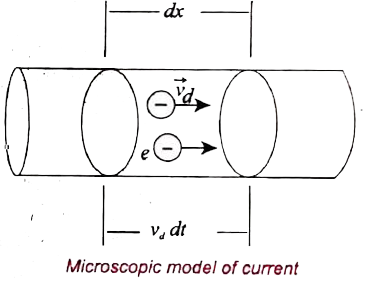
and obtain general form of Ohm.s law. Let us consider a conductor with area of cross section A and an electric field `vec E` applied from right to left. If there are n electrons per unit volume in the conductor. Then let us assume that all the electrons move with the same drift velocity `vec V _d`

Let the drift velocity of the electrons be `v_a` The electrons move through a distance du within a small interval of dt
`v_d = (dx)/(dt), dx = V_d "dt ...(1)"`
Since A is the area of cross-section of the conductor, the electrons available in the volume with time dt is
= volume `xx` number per unit volume
` = Adx xx n " ...(2)"`
Substituting for dx form equation (1) in (2)
` = (A v_d dt) n`
Total charge in volume element dQ = (charge) `xx` (number of electrons in the volume element )
` dQ = (e) (A v_d dt) n`
Hence the current
`I = (dQ)/(dt) = (ne A n_d dt)/(dt) `
` I = ne A v_d " ...(3)`
Current density (J)
The current density (J) is defined as the current per unit area of cross-section of the conductor,
`J = I / A`
The S.I unit of current density is `A/m_2`
(i.e.) A `m^(-2)`
` J= (ne Av_d)/A` ( from equation (3))
` J = nev_d" ...(4)"`
This expression holds only when the direction of the current is perpendicular to the area A. In general, the current density is a vector quantity. It is given by
`vecJ = ne vecv_d`
Substituting `vecv_d ` from equation `vecv_d = (e tau )/m vecE`
`vec J = (n* e^2 tau )/m vecE" ...(5) "`
`vec J = sigma vecE" ...(6)"`
where `sigma = (ne^2 tau )/m ` is is called conductivity. The equation (5) is called microscopic form of Ohm.s law.
Promotional Banner

Similar Questions

Explore conceptually related problems

Describe the fluid mosaic model of cell membrane.

State Ohm's law .

State microscopic form of Ohms' law.

