Home
Class 12
PHYSICS
Prove that in a pure resistive circuit t...

Prove that in a pure resistive circuit the current is in phase with the applied voltage.

Text Solution

Verified by Experts
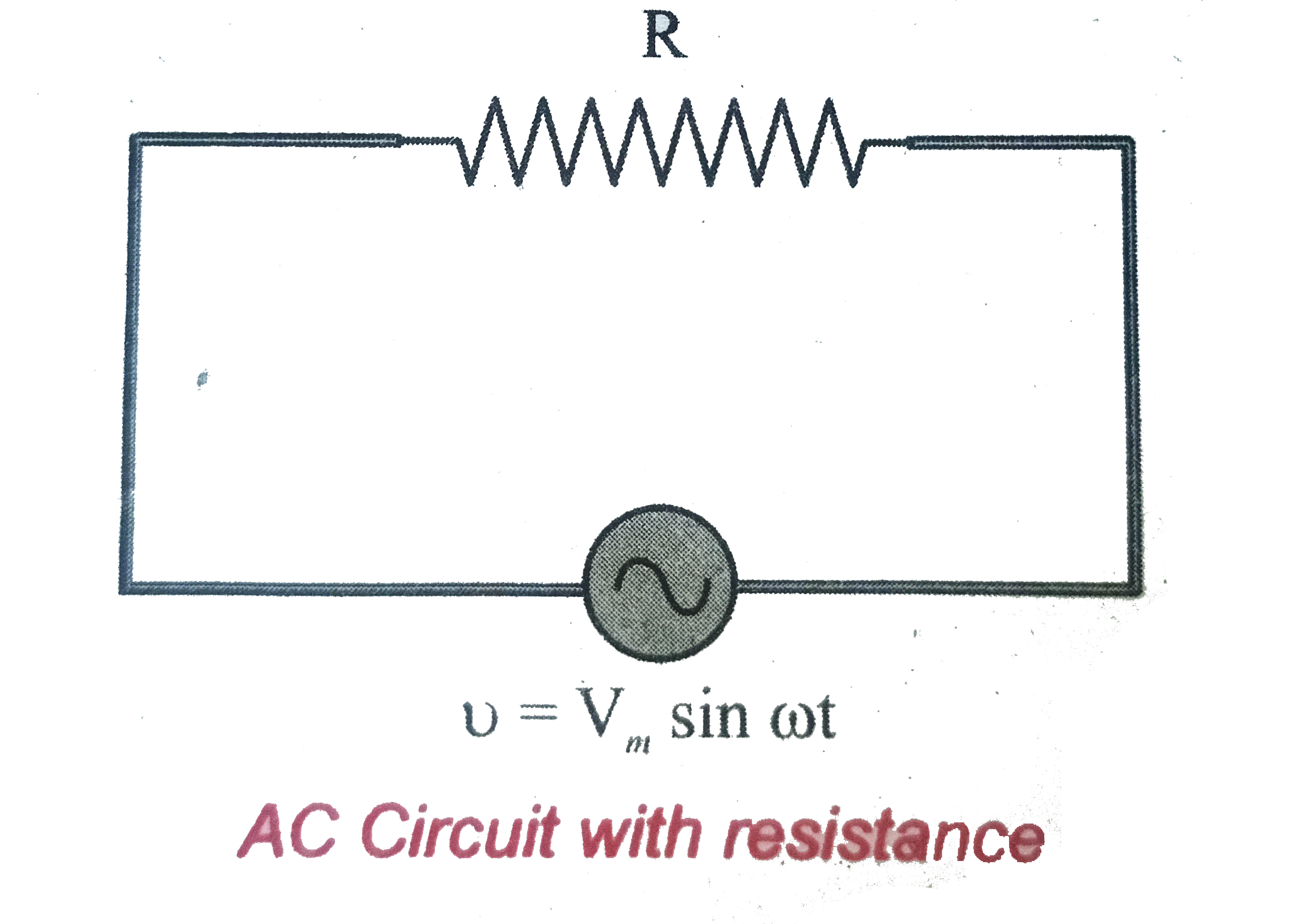

Consider a circuit containing a pure resistor of resistance R connected across an alternating voltage source. The instantaneous value of the alternating voltage is given by
`upsilon=V_(m)=sin omegat" ...(1)"`
An alternating current i flowing in the circuit due to this voltage, develops a potential drop across R and is given by
`V_(R)=iR" ....(1)"`
Kirchhoff .s loop rule states that the algebraic sum of potential differences in a closed circuit is zero. For this resistive circuit,
`upsilon-V_(R)=0`
From equation (1) and (2),
`V_(m)sin omega t=iR`
`i=(V_(m))/(R ) sin omegat`
`i=I_(m) sin omegat" ...(3)"`
where `(V_(m))/(R )=I_(m),` the peak value of alternating current in the circuit, From equations (1) and (3), it is clear that the applied voltage and the current are in phase with each other in a resistive circuit. It means that they reach their maxima and minima simultaneously. This is indicated in the phasor diagram. The wave diagram also depicts that current is in phase with the applied voltage.
Promotional Banner

Similar Questions

Explore conceptually related problems

A lamp consumes only 25% of the peak power in an ac circuit. The phase difference between the applied voltage and the current is

An inductor coil joined to a 6 V battery draws a steady current of 12 A . This coil is connected to a capacitor and an AC source of rms voltage 6 V in series. If the current in the circuit is in phase with the emf, find the rms current.

In series circuit, the current remains ____ throughout the circuit.

In a LCR circuit, the voltage across an inductor, capacitor and resitance are 10V, 10V and 30V respectively, what is the phase difference between the applied voltage and the current in the circuit?

A battery of emf 10Vand internal resistance 3 Omega is connected to a resistor.If the current in the circuit is 0.5A, what is the resistance of the resistor ? What is the terminal voltage ot the battery when the circuit is clossed ?

A transistor is used in common-emitter mode in an amplifier circuit. When a signal 20mV is added to the base-emmiter voltage,the base current changes by 20(mu)A and the collector current changes by 2mA.The load resistance is 5k(Omega) .Calculate (a)the factor (beta) (b)the input resistance R_(BE), (c) the transconductance and (d) the voltage gain .

An ac voltage is applied to a resistance R and inductor L in series If R and the inductive reactance are both equal to 3Omega the phase difference between the applied voltage and the current in the circuit is :

A battery of emf 10 V and internal resistance 3Omega is connected to a resistor. The current in the circuit is 0.5A. The terminal voltage of the battery when the circuit is closed is

In a circuit containing a capacitor and an AC source, the current is zero at the instant the source voltage is maximum. Is it consistent with Ohm's law?

