Home
Class 10
PHYSICS
The figure represents two bodies of mass...

The figure represents two bodies of masses 10 kg and 20 kg, moving with an initial velocity of `10 ms^(-1)` and `5 ms^(-1)` respectively. They collide with each other. After collision, they move with velocities `12 ms^(-1)` and `4 ms^(-1)` respectively. The time of collision is 2s. Now calculate `F_(1)` and `F_(2)`.

Text Solution

Verified by Experts
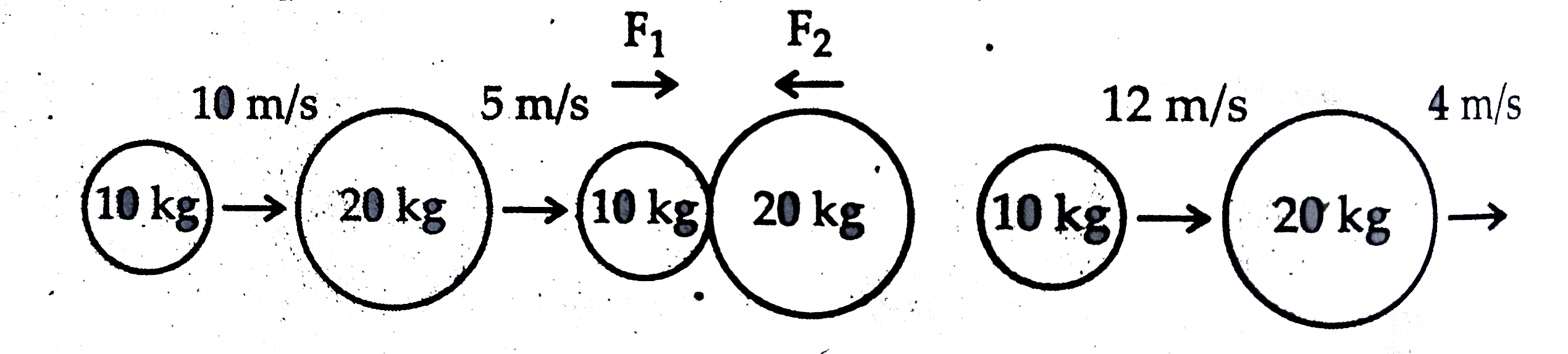

`m_(1) = 10 kg " " m_(2) = 20 kg`
`u_(1) = 10 ms^(-1) " " u_(2) = 5 ms^(-1)`
`v_(1) = 12ms^(-1)" " v_(2) = 4ms^(-1)`
Time of collision, t = 2s
`therefore` Force acting on 20 kg object
`F_(1) = m_(2)((v_(2)-u_(2))/(t)`
= `20((4-5)/(2))`
`F_(1) = -10 N`
Force acting on 10 kg object
`F_(2) = m_(1)((v_(1)-u_(1))/(t))`
` = 10((12-10)/(2))`
`F_(2) = 10N`
Promotional Banner

Similar Questions

Explore conceptually related problems

What will be the wavelength of a ball of mass 0.1 kg moving with a velocity of 10 ms^(-1) ?

Two bodies of mass 60 kg and 30 kg moving in the same direction along straight line velocity 40cms^(-1) and 30cms^(-1) respectively suffer one dimensional elastic collision. Find their velocities after collision

Two objects of masses 100 g and 200 g are moving along the same line and direction with velocities of 2 m s-1 and m s-1 respectively. They collide and after the collision, the first object moves at a velocity of 1.67 ms-1. Determine the velocity of second object.

The velocity of image when object and mirror both are moving towards each other with velocities 4 ms^(-1) and 5 ms^(-1) respectively, is

Two equal masses m_(1) and m_(2) are moving along the same straight line with velocities 5ms^(-1) and -9 ms^(-1) respectively. If the collision is elastic, then calculate the velocities after the collision of m_(1) and m_(2) , respectively

A spere of mass 20 kg moving with a velocity 40 ms^(-1) collides with another sphere of mass 15 kg which is at rest . After collision they move with the same velocity . Find the velocity .

