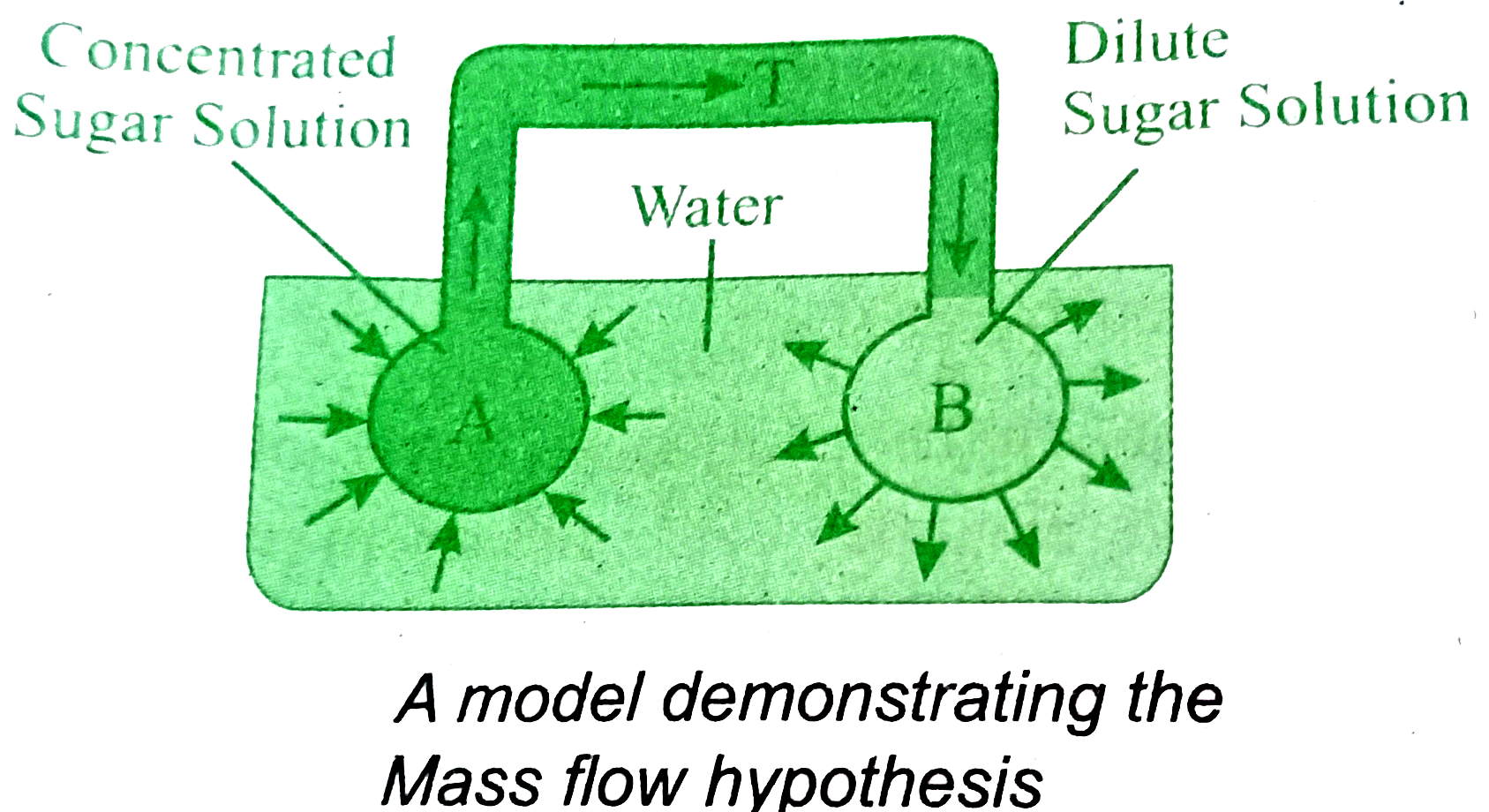
Mass flow theory was First proposed by Munch (1930) and elaborated by Crafts (1938).According to this hypothsis ,organic substances or solutes move from the region of high osmotic pressure (from mesophyll) to the region of flow osomtic pressure along the turgr pressure gradient.The principle involved in this hypothesis can be explained by a simple physical system as shown in figure.
Two chambers "A" and "B" made up of semipermeable membranes are connected by tube "T" imersed in a reserevoir of water .Chamber "A" contains highly concentrated sugar solution while chamber "B"contains dillute sugar solution.The following changes were observed in the system.
(i)The high concentration sugar solution of chamber "A" is in hypertonic state which draws water from the reservoir by endosmosis.
(ii)Due to the continuous entry of water into chamber "A", tugor pressure is icreased .
(iii)Increase in turgor pressure in chamber "A"force ,the mass flow of sugar solution to chamber "B" through the tube "T"along turgor pressure gradient.
(iv)The movement of solute will continue till the solution in both condition and the system becomes inactive.
(v)However,if new sugar solution is added in chamber "A" , the system will start to run again.
A similar analogous system as given in the experiment exists in plant:Chamber"A" is analogous to mesophyll cells of the leaves which contain a higher concentration of food material in soluble form .In short"A" is the production point called "source".
Chamber "B" is analogous to cells of stem and roots where the food material is utilized. In short "B" is consumption end called "sink". Tube "T" is analogous to the sieve tube of phloem.
Mesphyll cells draw water from the xylem(reservoir of the experiment) to the leaf by endosmosis leading to increase in the turgor pressure of mesophyll cell.The turgor pressure in the cells of stem and the roots are comparatively and low and masse from mesoohyll through the phloem to the cells of stem and root along the gradient turgor pressure.In the cells of stem and roots ,the organic solutes are either consumed or converted into insoluble from and the excess wateris released into xylem (by turgor pressure gradient)through cambium.
(i)When a woody or herbaceous plant is girded,the sape contains high sugar containing exudates from cut end.
(ii)Positive concentration gradient disappeears when plants are defoliated.
Objection:
(i)This hypothesis explains the undirectional movement of solute is commonly observed in plants.
(ii)Osmotic pressure of mesophyll cells and that of root hair do not confirm the requirements.
(iii)This thoery gives passive role to sieve tube and protoplasm,while some workers demonstarted the involevement of ATP.


