Home
Class 11
BIOLOGY
Explain non-cyclic photophosphorylation....

Explain non-cyclic photophosphorylation.

Text Solution

Verified by Experts
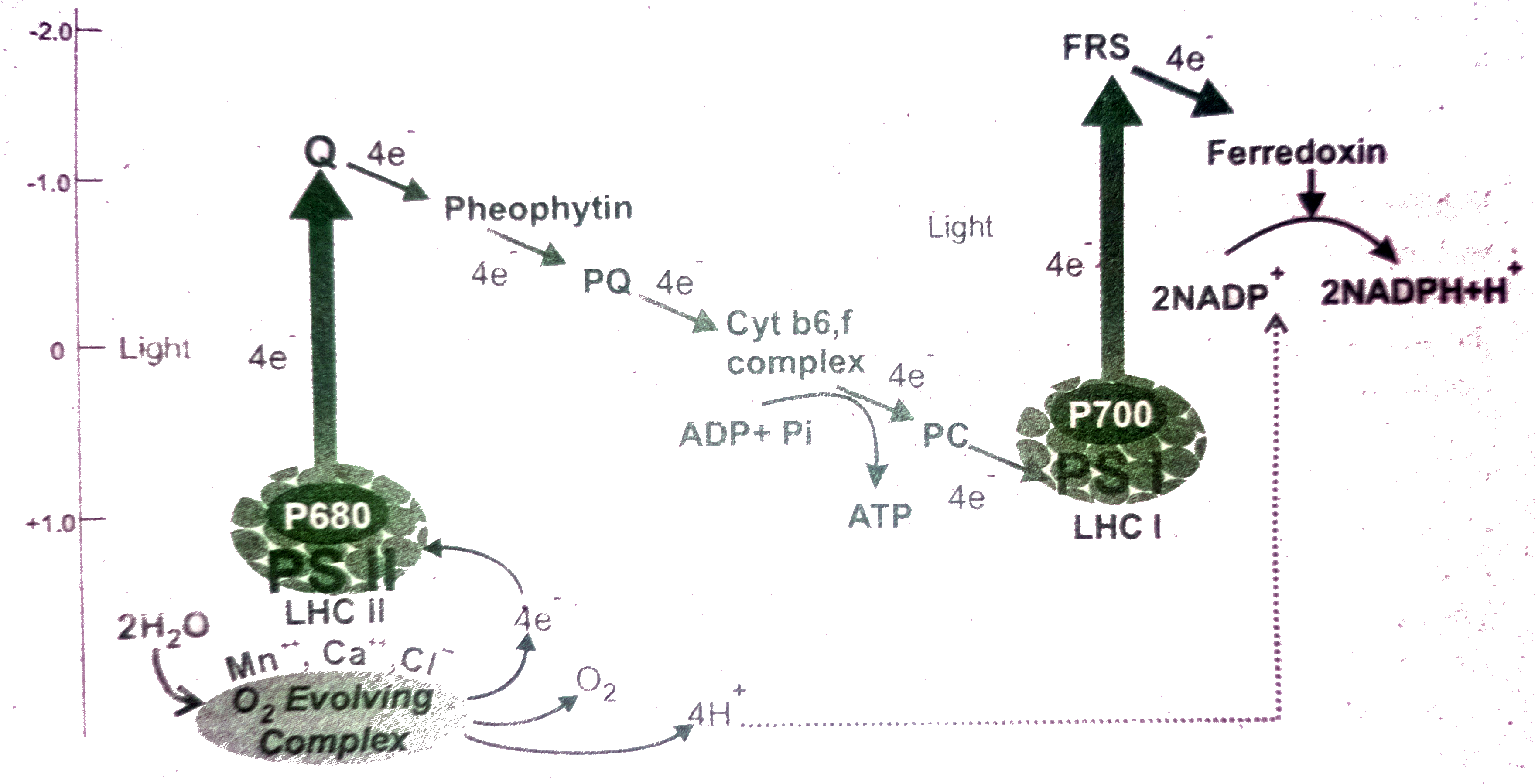
When photons are activated reaction centre of pigment system II(P680), electrons are moved to the high energy level. Electrons from high energy state passes through series of electron carriers like pheophytin, plastoquinone, cytochrome complex,

plastocyanin and filly accepted by PS I (P700). During this movement of electrons from PS II to PS I ATP is generated. PS I (P700) is activated by light. electrons are moved to high energy state and accepted by electron acceptor molecule ferredoxin reducing Substance (FRS). During the downhill movement through ferredoxin, electrons are transferred to `DP^+` and reduced into `DPH + H^+` (`H^+` formed from splitting of water by light).
Electrons released from the photosystem II are not cycled back. It is used from the reduction of `DP^+` in to DPH + `H^+`. During the electron transport it generates ATP and hence this type of photophosphorylation is called non-cyclic photophosphorylation. The electron flow looks like the appearance of letter .Z. and so known as Z scheme.
When there is availability of `DP^+` for reduction and when there is splitting of water molecules both PS I and PS II are activated. Non-cyclic electron transport PS I and PS II both are involved co-operatively to transport electrons from water to `DP^+`. In oxygenic species non-cyclic electron transport takes place in three stages.
(i) Electron transport from water to P680: Splitting of water molecule produce electrons, protons and oxygen. Electrons lost by the PS II (P680) are replaced by electrons from splitting of water molecule.
(ii) Electron transport from P680 to P700: Electron flow starts from P680 through a series of electron carrier molecules like pheophytin, plastoquinone (PQ), cytochrome `b_6-f` complex, plastocyanin (PC) and filly reaches P700 (PS I).
(iii) ELectron transort from P700 to `DP^+`: PS I (P700) is excited now and the electrons pass to high energy level. When electron travels downhill through ferredoxin, `DP^+` is reduced to DPH + `H^+`.
Promotional Banner

Topper's Solved these Questions

  • PHOTOSYNTHESIS

    PREMIERS PUBLISHERS|Exercise Other Important Questions & Answers CHECK YOUR GRASP |3 Videos
  • PHOTOSYNTHESIS

    PREMIERS PUBLISHERS|Exercise Other Important Questions & Answers -III. Answer the following. (3 Marks)|12 Videos
  • NEURAL CONTROL AND CO-ORDINATION

    PREMIERS PUBLISHERS|Exercise SOLUTION TO TEXTUAL QUESTIONS(Text Book Page No. 71)|1 Videos
  • PLANT GROWTH AND DEVELOPMENT

    PREMIERS PUBLISHERS|Exercise OTHER IMPORTANT QUESTIONS & ANSWERS (ANSWER THE FOLLOWING) (5 MARKS) |8 Videos

Similar Questions

Explore conceptually related problems

Explain cyclic photosphosphorylation .

Give comparison between the following: (a) C_(3) and C_(4) pathways (b) Cyclic and non-cyclic photophosphorylation (c) Anatomy of leaf in C_(3) and C_(4) plants

Tabulate any two differences between Cyclic and Non-Cyclic photphosphorylation.

Identify the wrong statement from the below about ''Non-cyclic photophosphorylation''

Assertion: Non cyclic photophosphorylation occurs in the stroma of chloroplast. Reason: There is a continous flow of electrons in this process.

Differentiate Cycle and Non-Cycle photophosphorylation.

