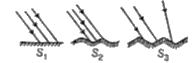
A
B
C
D
Text Solution
Verified by Experts
The correct Answer is:



Similar Questions
Explore conceptually related problems
Recommended Questions
- Light is falling on the surfaces S(1),S(2)andS(3) as shown below. ...
Text Solution
|
- Light of wavelength 6000 Å falls on a plane reflecting surface. What a...
Text Solution
|
- Light of wavelength 5000Å falls on a plane reflecting surface. What ar...
Text Solution
|
- S(1) and S(2) are two equipotential surfaces on which the potentials a...
Text Solution
|
- An unpolarized light beam is incident on a surface at an angle of inci...
Text Solution
|
- A light ray is incident on a smooth reflecting surface making an angle...
Text Solution
|
- A ray of light makes an angle of 50^(@) with the surface S(1) of the g...
Text Solution
|
- A ray of light makes an angle of 50^(@) with the surface S(1) of the g...
Text Solution
|
- A ray of light makes an angle of 50^(@) with the surface S(1) of the g...
Text Solution
|