(In figure, (+) denotes the male person and (-) denotes the female person)
1) The one who is 43 years old is the spouse of the one whose age is a perfect square of a number.
2) The one who is 43 years old sits second to the right of P. Here, we have two possible cases i.e.
Case 1 and Case 2:
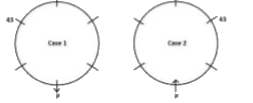
3) The one who is 43 years old faces outside the table.
4) The husband of T sits to the immediate right of the one who is 43 years old.
5) P is 2 years elder than the husband of T.
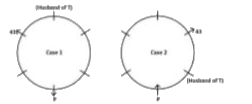
6) S sits opposite to U who does not sit adjacent to P.
7) S does not sit to the immediate right of P.
8) The one who is 51 years sits second to the left of S.
Here, we have two more possible
cases i.e. Case 1a and Case 2a:
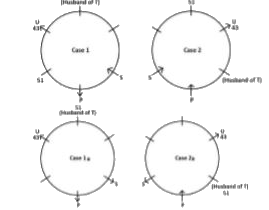
9) The one who is 49 years old sits second to the right of S.
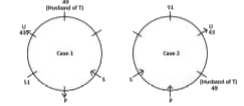
(In Case 1: There is no position left for T because T does not sit adjacent to her husband and her age is less than her husband. So, Case 1 gets eliminated.)
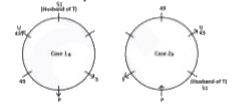
(In Case 1a: The position left for T where T is 49 years old and her husband is 51 years old and it is not possible as the ages of both person cannot be and odd number. So, Case 1 gets eliminated.)
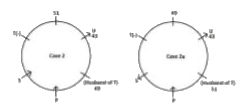
10) The wife of S is 5 years younger than S.
(U is 43 years old and is the spouse of the one whose age is a perfect square of a number. So, U is not the wife of S)
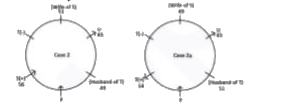
11) T is 7 years younger than her husband.
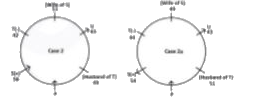
12) The difference between the ages of T and P is 6 years.
Now, it is clear that the spouse of U is
P, so P’s age is a perfect square.
In Case 2:
If P – T = 6, T = 42 so P = 48,
If T – P = 6, T = 42 so P = 36
In Case 2a:
If P – T = 6, T = 44 so P = 50,
If T – P = 6, T = 44 so P = 38.
Hence, Case 2a gets eliminated:
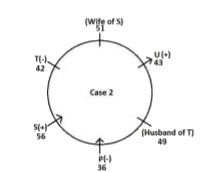
13) Q is not the neighbour of T. Here, we have the final arrangement:
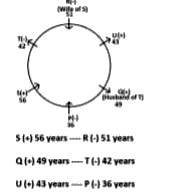
Clearly, Q is the husband of the one who sits to the immediate left of S.


