Home
Class 12
CHEMISTRY
The volume-temperature graphs of a given...

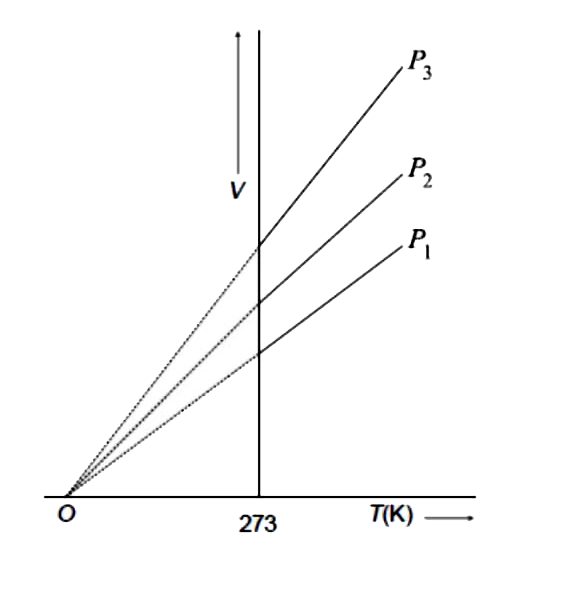
The volume-temperature graphs of a given mass of an ideal gas at constant pressures are shown below. What is the correct order of pressures ?

A

`p_(1) gt p_(3) gt p_(2)`

B

`p_(1) gt p_(2) gt p_(3)`

C

`p_(2) gt p_(3) gt p_(1)`

D

`p_(2) gt p_(1) gt p_(3)`

Text Solution

Verified by Experts

The correct Answer is:

B

Drawing a constant temperature line parallel to .V. axis, the isobar at higher volumes will be at lower pressure as `P prop 1/V` at constant temperature.
Promotional Banner

Topper's Solved these Questions

  • SOME BASIC CONCEPTS OF CHEMISTRY

    NTA MOCK TESTS|Exercise MULTIPLE CHOICE QUESTIONS|30 Videos
  • STRUCTURE OF ATOM TEST -1

    NTA MOCK TESTS|Exercise MULTIPLE CHOICE QUESTIONS|30 Videos

Similar Questions

Explore conceptually related problems

The volume-temperature graphs of a given mass of an ideal gas at constant pressure are shown below. What is the correct order of pressure ?

The raise in the temperature of a given mass of an ideal gas at constant pressure and at temperature 27^@ to double its volume is

The volume of a given mass of a gas in vessel is reduced to half at constant temperature. What is the charge in pressure?

Volume versus temperature graphs for a given mass of an ideal gas are shown in Fig. at two different values of constant pressure. What can be inferred about relation between P_(1) and P_(2) ?

Volume versus temperature graphs for a given mass of an ideal gas are shown in figure. At two different values of constant pressure. What can be inferred about relation between P_(1) and P_(2) ?

At what temperature would the volume of a given mass of a gas at constant pressure will be twice of its volume at 0^(@)C

Assertion : The volume of a given mass of a gas at constant pressure is directly proportinal to its kelvin temperature. Reason : The pressure of a fixed mass of a gas at constant volume is directly proportinal to the kelvin temperature.

NTA MOCK TESTS-STATES OF MATTER : GASES AND LIQUIDS-SINGLE CHOICE QUESTION
  1. At 10^@C, the density of a fixed mass of an ideal gas divided by its p...

    Text Solution

    |

  2. Calculate the total pressure in a 10.0 L cylinder which contains 0.4 g...

    Text Solution

    |

  3. The volume-temperature graphs of a given mass of an ideal gas at const...

    Text Solution

    |

  4. An open vessel at 27 ^@C is heated until 3/8th of the air in it has be...

    Text Solution

    |

  5. The rates of diffusion of SO(2), CO(2), PCl(3) and SO3 are in the fol...

    Text Solution

    |

  6. The density of a gas-filled electric lamp is 0.75, after the lamp has ...

    Text Solution

    |

  7. The rms speed of N2 molecules in a gas is u. If the temperature is dou...

    Text Solution

    |

  8. A gas obeys the equation of state P(Vm – b) = RT. The slope of the iso...

    Text Solution

    |

  9. In the following reaction, we start with 2 mol of N2 and 5 mol of H2 e...

    Text Solution

    |

  10. The weight of 350 mL of a diatomic gas at 0^@C and 2 atm pressure is 1...

    Text Solution

    |

  11. For the given isotherm for one mole of an ideal gas, which follows Boy...

    Text Solution

    |

  12. An ideal gas is initially at temperature T and volume V. It's volume i...

    Text Solution

    |

  13. What is the correct relation between critical temperature Tc, Boyle's ...

    Text Solution

    |

  14. If the rate of diffusion of A is 5 times that of B, what will be the d...

    Text Solution

    |

  15. At what temperature will the molar kinetic energy of 0.3 mol of He be ...

    Text Solution

    |

  16. A mixture of dihydrogen and dioxygen at one bar pressure contains 20% ...

    Text Solution

    |

  17. Consider the following graph: X, Y and Z can be respectively.

    Text Solution

    |

  18. A sample of air contains only N(2), O(2) and H(2). It is saturated wi...

    Text Solution

    |

  19. For 1 mol of an ideal gas, V(1) gt V(2) gt V(3) in fig. 1, T(1) gt T(2...

    Text Solution

    |

  20. A gas can be compressed to a fraction of its volume. The same volume o...

    Text Solution

    |
