

Home
Class 8
PHYSICS
Answer the following : Figure (I) and ...

Answer the following :
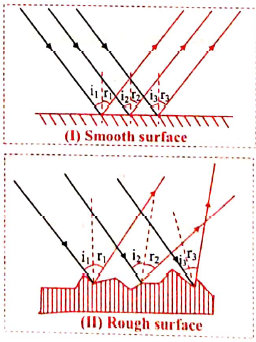
Figure (I) and (II) show three parallel rays , shown in black , incident on smooth and rough surfaces . The reflected rays are drawn using laws of reflection shown in colour :
Rays reflected from which surface are parallel to one another ? :

Promotional Banner

Topper's Solved these Questions

  • MEASUREMENT AND EFFECTS OF HEAT

    TARGET PUBLICATION|Exercise EXERCISE|121 Videos
  • SOUND

    TARGET PUBLICATION|Exercise EXERCISE|85 Videos

Similar Questions

Explore conceptually related problems

Answer the following : Figure (I) and (II) show three parallel rays , shown in black , incident on smooth and rough surfaces . The reflected rays are drawn using laws of reflection shown in colour : What conclusion can you draw from the figure ? :

Give reasons : In irregular reflection of light , the reflected rays are not parallel to one another .

Fill in the blanks : All the reflected rays from regular surface are ……….. To each other .

Fill in the blanks : When light rays are incident on a smooth surface , they undergo ……….. Reflection .

Answer the following : If the angle of reflection is 40⁰ , what angle must the incident ray make with the normal ?

Questions based on diagram : Draw a figure showing the following : Reflected rays :

The angle made by incident ray of light with the reflecting surface is called

Answer the following : Name the following : Rays going away from the surface after reflection .

Answer the following questions: In the case of a concave mirror, show the path of the reflected ray when the Incident ray of light passes through the centre of curvature of the mirror.

Answer the following questions: In the case of a concave mirror, show the path of the reflected ray when the Incident ray of light Is parallel to the principal axis of the mirror.

TARGET PUBLICATION-REFLECTION OF LIGHT-EXERCISE
  1. Answer the following : Describe an experiment to prove that the angl...

    Text Solution

    |

  2. Answer the following : What will happen when a light ray is incident...

    Text Solution

    |

  3. Answer the following : Figure (I) and (II) show three parallel rays ...

    Text Solution

    |

  4. Answer the following : Figure (I) and (II) show three parallel rays ...

    Text Solution

    |

  5. Answer the following : Classify the below surfaces into forming regu...

    Text Solution

    |

  6. Answer the following : How do you see if the barber in a saloon has ...

    Text Solution

    |

  7. Answer the following : What type of image do we see in a mirror ? Wh...

    Text Solution

    |

  8. Give reasons : We are able to see the image of the moon in water .

    Text Solution

    |

  9. Answer the following : Explain the construction and working of a kal...

    Text Solution

    |

  10. Answer the following : state some uses of kaleidoscope ?

    Text Solution

    |

  11. Answer the following : Explain the construction and working of a per...

    Text Solution

    |

  12. Answer the following : Write short note on uses of periscope ?

    Text Solution

    |

  13. Answer the following : Give any four examples where multiple reflect...

    Text Solution

    |

  14. Give reasons : In irregular reflection of light , the reflected rays...

    Text Solution

    |

  15. Give reasons : It is easier to read from rough pages than glossy pag...

    Text Solution

    |

  16. Give reasons : We are able to see the image of the moon in water .

    Text Solution

    |

  17. Distinguish between : Explain the difference between regular and irre...

    Text Solution

    |

  18. Complete the given chart/ table : Complete the following flow chart ...

    Text Solution

    |

  19. Questions based on diagram : Draw a figure showing the following : ...

    Text Solution

    |

  20. Questions based on diagram : Draw a figure showing the following : ...

    Text Solution

    |