

Home
Class 9
PHYSICS
Use your brain power: Amar, Akbar and ...

Use your brain power:
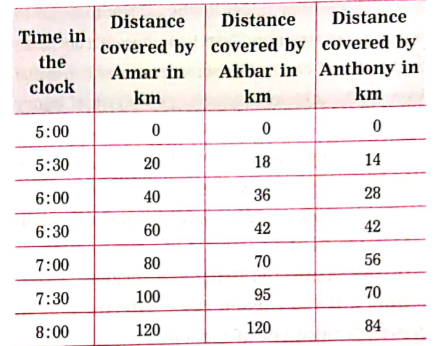
Amar, Akbar and Anthony are travelling in different cars with different velocities. The distance covered by them during different time intervals are given in the following table.
Considering the distances covered by Amar, Akbar, Anthony in fixed time intervals, what can you say about their speeds?

Promotional Banner

Topper's Solved these Questions

  • LAW OF MOTION

    BAL BHARTI|Exercise Exercises|18 Videos
  • LAW OF MOTION

    BAL BHARTI|Exercise Can you recall?|2 Videos
  • INFORMATION COMMUNICATION TECHNOLOGY : THE NEW DIRECTION OF PROGRESS

    BAL BHARTI|Exercise EXERCISE |3 Videos
  • OBSERVING SPACE: TELESCOPES

    BAL BHARTI|Exercise EXERCISES |6 Videos

Similar Questions

Explore conceptually related problems

Use your brain power: Amar, Akbar and Anthony are travelling in different cars with different velocities. The distance covered by them during different time intervals are given in the following table. Are all the distances covered by Akbar in the fixed time intervals the same?

Use your brain power: Amar, Akbar and Anthony are travelling in different cars with different velocities. The distance covered by them during different time intervals are given in the following table. Who has covered equal distance in equal time intervals?

Use your brain power: Amar, Akbar and Anthony are travelling in different cars with different velocities. The distance covered by them during different time intervals are given in the following table. What is the time interval between the noting's of distances made by Amar, Akbar and Anthony?

Answer the following questions: The following table shown the distance covered by a car in fixed time intervals. Draw a graph of distance against time taking 'time' along the X-axis and 'distance' along the Y-axis.

Answer the following questions: The changes in the velocity of a car in specific time intervals are given in the following table.The velocty-time graph in figure shows that, The velocity changes by equal amounts in equal time intervals. Thus, this is uniformly accelerated motion. How much does the velocity change in every 5 seconds? Find the distance covered by the car in the time interval 10 seconds to 20 seconds.

In a certain time interval, the velocity of a car reduces from 72 km/h to 36 km/h. If the car covers a distance of 150 m during this time interval, find the retardation of the car.

Suppose you are listening to an out-door live concert sitting at a distance of 150m from the speakers. Your friend is listening to the live broadcast of the concert in another country and the radio signal has to travel 3000 km. to reach him. Who will hear the music first and what will be the time difference between the two? Velocity of light = 3 xx 10^8m//s and that of sound is 330m//s .

Read the following paragraph and answer the questions given below it: The resistance of a metal falls when cooled below room temperature. Many scientists believed that the value of the resistance would become constant at some very low temperature, allowing the current to flow with little or no resistance. H. K. Onnes successfully liquefied helium in 1908 by cooling it to about 4 K. In 1911, while investigating the electrical property of very pure mercury. Onnes discovered that at a temperature of 4.2 kelvin, its resistance practically vanished. This new state, on account of its extraordinary property, is now called the superconducting state and the phenomenon is called superconductivity. A superconductor, below a certain critical temperature, offers almost zero resistance to a flow of current through it. Onnes also discovered that a superconductor exhibits persistent current: once set up, the current continues to flow for a very long time without an electric potential difference driving it and without significant loss. Superconductivity is used in many diverse areas, such as magnetically levitated trains, transmission of electricity, increasing speed of computers, in MRI (magnetic resonance imaging). What is special about a superconductor?

Read the following paragraph and answer the questions given below it: The resistance of a metal falls when cooled below room temperature. Many scientists believed that the value of the resistance would become constant at some very low temperature, allowing the current to flow with little or no resistance. H. K. Onnes successfully liquefied helium in 1908 by cooling it to about 4 K. In 1911, while investigating the electrical property of very pure mercury. Onnes discovered that at a temperature of 4.2 kelvin, its resistance practically vanished. This new state, on account of its extraordinary property, is now called the superconducting state and the phenomenon is called superconductivity. A superconductor, below a certain critical temperature, offers almost zero resistance to a flow of current through it. Onnes also discovered that a superconductor exhibits persistent current: once set up, the current continues to flow for a very long time without an electric potential difference driving it and without significant loss. Superconductivity is used in many diverse areas, such as magnetically levitated trains, transmission of electricity, increasing speed of computers, in MRI (magnetic resonance imaging). At what temperature does the resistance of very pure mercury become almost zero?