

Home
Class 9
PHYSICS
Answer the following questions: A train...

Answer the following questions:
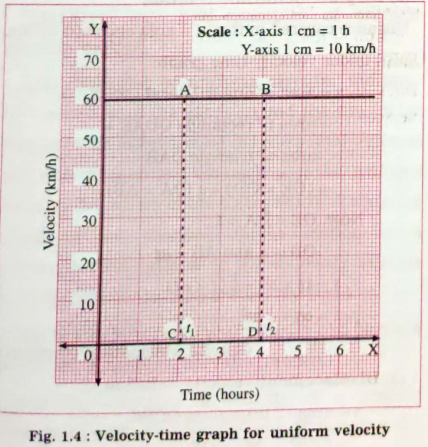
A train is moving with a uniform velocity of 60km/hour for 5 hours. The velocity-time graph for this uniform motion show in figure.
i. With the help of the graph, how will you determine the distance covered by the train between 2 and 4 hours

Promotional Banner

Topper's Solved these Questions

  • LAW OF MOTION

    BAL BHARTI|Exercise Exercises|18 Videos
  • LAW OF MOTION

    BAL BHARTI|Exercise Can you recall?|2 Videos
  • INFORMATION COMMUNICATION TECHNOLOGY : THE NEW DIRECTION OF PROGRESS

    BAL BHARTI|Exercise EXERCISE |3 Videos
  • OBSERVING SPACE: TELESCOPES

    BAL BHARTI|Exercise EXERCISES |6 Videos

Similar Questions

Explore conceptually related problems

Answer the following questions: A train is moving with a uniform velocity of 60km/hout for 5 hours. The velocity-time graph for this uniform motion show in figure. Is there a relation between the distance covered by the train between 2 and 4 hours and the area of a particular quadrangle in the graph? What is the acceleration of the train?

Answer the following questions: The changes in the velocity of a car in specific time intervals are given in the following table. Explain For all uniformly accelerated motions, the velocity-time graph is a straight line.

Answer the following questions: The changes in the velocity of a car in specific time intervals are given in the following table. The velocty-time graph in figure shows that, For nonuniformly accelerated motions, the velocity-time graph may have any shape depending on how the acceleration changes with time.Explain.

Answer the following questions in your words: A bus covers a distance of about two hundred kilometers from solapur to pune in five hours. How much distance does the bus cover in one hour?

Answer the following questions: The changes in the velocity of a car in specific time intervals are given in the following table.The velocty-time graph in figure shows that, The velocity changes by equal amounts in equal time intervals. Thus, this is uniformly accelerated motion. How much does the velocity change in every 5 seconds? Find the distance covered by the car in the time interval 10 seconds to 20 seconds.

A body starting with an initial velocity of 5 m//s , moves with a uniform acceleration of 2 m//s^(2) . After some time it attains a velocity of 13 m//s . Find the distance covered by the body during this period.

Solve the following questions. (ii) A train travels 360 km with uniform speed. The speed of the train is increased by 5 km//hr , it takes 48 minutes less to cover the same distance. Find the initial speed of the train.

Using velocity time graph, derive the equations of motion for uniform acceleration moving along a straight line.

The initial velocity of a body is 10 m//s . If it is moving with a uniform acceleration of 3 m//s^(2) in the direction of motion, calculate the distance covered by the body in 20 seconds.