Home
Class 12
PHYSICS
Point charges are placed at the vertices...

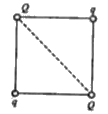
Point charges are placed at the vertices of a square of side 'a' as shown in fig. What should be the sign of charge q and magnitude of the ratio `|(q)/(Q)|` so that
net force on each q is zero?
Is it possible that the entire system could be in electrostatic equilibrium?

Text Solution

Verified by Experts

Consider the forces acting on charge Q placed at A
Case I. Let the charges q and Q be of same sign.
Here, `F_(1)=(1)/(4piepsilon_(0))(qQ)/(a^(2))` (force of q at D on Q at A)
`F_(2)=(1)/(4piepsilon_(0))(qQ)/(a^(2))` (force of q at B on Q at A)
`F_(3)=(1)/(4piepsilon_(0))(Q Q)/(2a^(2))` (force of Q at C on Q at A)
In figure (a), the resultant of forces `vecF_(1) and vecF_(2)` will lie along `vecF_(3)` so that the net force on Q cannot be zero.
Hence, q and Q have to be of opposite signs.
Case II. (i) Let the charges q and Q be of opposite signs. In this case,as shown in fig. (b), resultant of `vecF_(1)` and `vecF_(2)` will be opposite to `vecF_(3)` so that it becomes possible to obtain a condition of zero net force. Let us write `vecF_(R)=vecF_(1)+vecF_(2)`. So `sqrt(F_(1)^(2)+F_(2)^(2))=(1)/(4piepsilon_(0))(qQ)/(a^(2))sqrt(2)`
The direction of `vecF_(R)` will be along AC `vecF_(R)`, being the resultant of forces of equal magnitude, bisects the angle between the two). `vecF_(R)` and `vecF_(3)` are in opposite directions. The force on Q can be zero if their magnitudes are also equal, i.e.,
`(1)/(4piepsilon_(0))(qQ)/(a^(2))sqrt(2)=(1)/(4piepsilon_(0))(Q Q)/(2a^(2))or(Q)/(4piepsilon_(0)a^(2))(qsqrt(2)-(Q)/(2))=0`
or `q=(Q)/(2sqrt(2))or|(q)/(Q)|=(1)/(2sqrt(2)){Qne0}`
Therefore, the sign of q should be the negative of Q.
Promotional Banner

Similar Questions

Explore conceptually related problems

A point charge Q is place at the center of a cube of side, l lthe electric flux emerging the cube is
