Home
Class 12
PHYSICS
Use the diagram below to answer the foll...

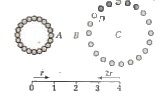
Use the diagram below to answer the following questions. 40 spheres of equal mass make two rings of 20 spheres each. The ring on the right has a radius twice as large as the ring on the left.

At what position could a mass be placed so that the gravitational force that it would experience would be the same from both rings?

A

A

B

B

C

C

D

D

Text Solution

Verified by Experts

The correct Answer is:

b
Promotional Banner

Similar Questions

Explore conceptually related problems

A uniform rig of mas m and radius a is placed directly above a uniform sphre of mass M and of equyal radius. The centre of the ring is at a distance sqrt3 a from the centre of the sphere. Find the gravitational foerce exerted by the sphere on the ring.

Two rings having masses M and 2M respectively, having the same radius are placed coaxially as shown in the figure. If the mass distribution on both the rings is non-uniform, then the gravitational potential at point P is

A uniform ring of mass m is lying at a distance sqrt(3) a from the centre of mass M just over the sphere (where a is the radius of the ring as well as that of the sphere). Find the magnitude of gravitational force between them .

A mass m is placed at point P lies on the axis of a ring of mass M and radius R at a distance R from its centre. The gravitational force on mass M is

Two spheres of same mass and radius are in contact with each other. If the moment of inertia of a sphere about its diameter is I, then the moment of inertia of both the spheres about the tangent at their common point would be

We know that when two equal masses are placed on a line then, gravitational force on a third mass is zero due to these two masses when the third is placed at the centre of line joining the two masses. But if third mass is placed anywhere else on the x-axis, the gravitational force acts on that mass due to these two masses. Consider a system shown in figure. In this system two point masses of mass M each are placed at y-axis at a distance a from origin and these masses are fixed. If a third point mass of mass m is released at a distance x from origin on x-axis, then answer the following questions. The distance between positions of maximum force on mass m is

We know that when two equal masses are placed on a line then, gravitational force on a third mass is zero due to these two masses when the third is placed at the centre of line joining the two masses. But if third mass is placed anywhere else on the x-axis, the gravitational force acts on that mass due to these two masses. Consider a system shown in figure. In this system two point masses of mass M each are placed at y-axis at a distance a from origin and these masses are fixed. If a third point mass of mass m is released at a distance x from origin on x-axis, then answer the following questions. Which of the following graphs best represents the variation of force on mass m with distance x ?
