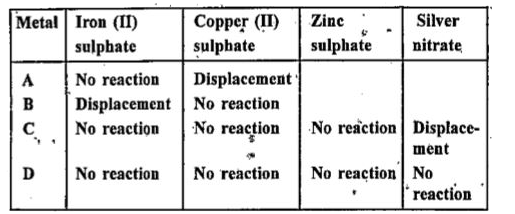
Samples of four metals A,B,C and D were taken and added to the following solution one by one. The results obtained have been tabulated as follows. Use the table above to answer the question about metals A, B, C and D: What would you observe if B is added to a solution of Copper (II) sulphate ?
Samples of four metals A,B,C and D were taken and added to the following solution one by one. The results obtained have been tabulated as follows. Use the table above to answer the question about metals A, B, C and D: Which is the most reactive metal ?
Observe the set of four figures A,B,C and D and answer the following questions. Which one of the figure shows mutualism?
Observe the set of four figures A,B,C and D and answer the following questions. what role is the insect performing in B?
Observe the set of four figures A,B,C and D and answer the following questions. What kind of association is show in D?
Observe the set of four figures A,B,C and D and answer the following questions. Name the organisms and their association in C.
Observe the set of 4 figures A,B,C and D answer the following questions: Name the organisms and the association in C.
Observe the set of 4 figures A,B,C and D answer the following questions: What kind of association is shown in D.
The following tables shows the position of six elements A, B, C, D, E ,and F in the periodic table? Using the table answer the following question:Out of D and E, which one has a bigger atmic radius and why?
The following rate data were obtained at 303 K for the following reaction : 2A +B rarr C+D The order of the reaction is :
NAND LAL PUBLICATION-METALS AND NON-METALS-ACTIVITY 3.8