Home
Class 14
MATHS
The following data presents count of rel...

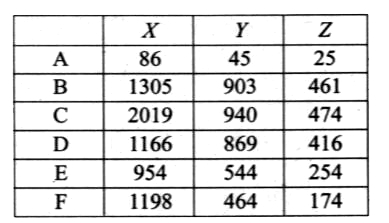
The following data presents count of released convicts who have served prison terms (X), those who have received some educational or technical training during their terms ( Y) and those who were offered. Company placement (Z ) respectively, from six different jails A,B,C,D,E and f, in the year 2010.

Jails with highest and smallest percentage of trained convicts are respectively.

A

F and D

B

D and F

C

C and A

D

D and A

Text Solution

Verified by Experts

Promotional Banner

Similar Questions

Explore conceptually related problems

The following data presents count of released convicts who have served prison terms (X), those who have received some educational or technical training during their terms ( Y) and those who were offered. Company placement (Z ) respectively, from six different jails A,B,C,D,E and f, in the year 2010. Jail with highest placement rate of trained convicts is

The following data presents count of released convicts who have served prison terms (X), those who have received some educational or technical training during their terms ( Y) and those who were offered. Company placement (Z ) respectively, from six different jails A,B,C,D,E and f, in the year 2010. Jails from which more than half of the trained convicts are offered jobs, are

In the following question, a given question is followed by information in three statements. You have to decide the data in which statement(s) is sufficient to answer the question and mark your answer accordingly. A, B, C, D, E and F are six employees. Each of them gets different number of mails–15,20,30, 50, 60 and 70 everyday but not necessarily in the same order. Who is the shortest among all and what is the number of mails that D gets? I. E is taller than only D and F. C is the tallest among all but does not get the least number of mails. A gets half the number of mails of what B gets. II. A is taller than B. The sum of mails of A and E is equal to the number of mails that D gets. The one, who gets 50 mails is not the shortest. D does not get the highest number of mails. III. A does not get 15 mails. B is not taller than A. D gets more mails than E but less than C.

