Home
Class 12
PHYSICS
In a experiment on metre bridge, if the ...

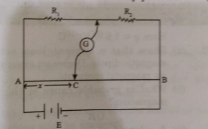
In a experiment on metre bridge, if the balancing length AC is 'x' what would be its value, when the radius of the metre bridge wire AB is doubled? Justify your answer.

A

There will be no change

B

Null point will shift to `L_(1)//2` point

C

Null point will shift to `2L_(1)` point

D

Null point will not be available

Text Solution

Verified by Experts

The correct Answer is:

A

For a balanced Meter Bridge `P//Q = L //(100-L_(1))`.
There is no parameter related to the radius of the wire. So, the null deflection of galvanometer does not depend on the radius of the wire. So, even if the radius of the wire is doubled, the null deflection of the galvanometer will not be changed.
Promotional Banner

Similar Questions

Explore conceptually related problems

In the shown arrangement of the experiment of the meter bridge if AC corroesponding to null deflection of galvanometer is x, what would be its value if the radius of the wire AB is doubled? .

In the shows arrangement of a meter bridge, if AC corresponding to null deflection of galvanometer is x, what would be its value if the radius of the wire AB is doubled?

In the metre bridge, the balancing length AB = 20 cm. The unknown resistance X is equal to

Statement I: In the meter bridge experiment shown in figure, the balance length AC corresponding to null deflection of the galvanometer is x. If the radius of the wire AB is doubled, the balanced length becomes 4x. Statement II: The resistance of a wire is inversely proportional to the square of its radius.

One ideal cell is used to drive current in a metre bridge circuit. In an experiment x is the balancing length obtained. If we replace the wire of the metre bridge with another wire of material having more rsistivity and lesser diameter, the new balancing length will be

In a metre bridge experiment l_(x) and l_(r) are the balancing lengths and R is known resistance then unkown, resistance is given by

Two wires of the same material and the length are connected to the two gaps of a metre bridge. The balancing length measured from left is 25cm. The ratio radius of the wire is the left gap to that in the right gap is

If in a meter bridge experiment, the balancing length l was 25 cm for the situation shown in the figure. If the length and diameter of the of wire of resistance R is made half, then find the new balancing length in centimetre is
