Negative Refractive Index:
One of the most fundamental phenomena in optics is refraction. When a beam of light crosses the interface between two different materials, its path is altered depending on the difference in the refractive indices of the materials. The greater the difference, the greater the refraction of the beam. For all known naturally occurring materials the refractive index assumes only positive values. But does this have to be the case?
In 1967, Soviet physicist Victor Veselago hypothesized that a material with a negative refractive index could exist without violating any of the laws of physics.
Veselago predicted that this remarkable material would exhibit a wide variety of new optical phenomena. However, until recently no one had found such a material and Veselago's ideas had remained untested. Recently, meta-material samples are being tested for negative refractive index. But the experiments show significant losses and this could be an intrinsic property of negative index materials.
Snell's law is satisfied for the material having a negative refractive index, but the direction of the refracted light ray is 'mirror-imaged about the normal to the surface.
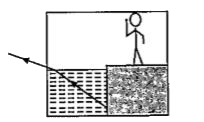
There will be an interesting difference in image formation if a vessel is filled with "negative water" having refractive index - 1.33 instead of regular water having refractive index 1.33.
Say, there is a fish in a vessel filled with negative water. The position of the fish is such that the observer cannot see it due to normal refraction since the refracted ray does not reach to his eye.
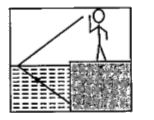
But due to negative refraction, he will be able to see it since the refracted ray now reaches his eye.
When the angle of incidence will be equal to angle of refraction for material having negative refraction index?


