Home
Class 12
PHYSICS
Which of the following graphs shows the ...

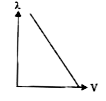
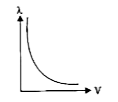
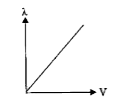
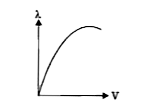
Which of the following graphs shows the variation of de-Broglie wavelength with potential through which a particle of charge q and mass m is accelerated ?

A

B

C

D

Text Solution

AI Generated Solution

The correct Answer is:

To solve the problem of determining the variation of de-Broglie wavelength (\(\lambda\)) with the potential (\(V\)) through which a charged particle (with charge \(q\) and mass \(m\)) is accelerated, we can follow these steps: ### Step 1: Understand the relationship between kinetic energy and potential When a particle with charge \(q\) is accelerated through a potential difference \(V\), its kinetic energy (\(KE\)) can be expressed as: \[ KE = qV \] ### Step 2: Relate kinetic energy to momentum The kinetic energy can also be expressed in terms of momentum (\(p\)): \[ KE = \frac{p^2}{2m} \] Equating the two expressions for kinetic energy gives: \[ qV = \frac{p^2}{2m} \] ### Step 3: Solve for momentum Rearranging the equation to find momentum \(p\): \[ p^2 = 2mqV \] \[ p = \sqrt{2mqV} \] ### Step 4: Use the de-Broglie wavelength formula The de-Broglie wavelength (\(\lambda\)) is given by: \[ \lambda = \frac{h}{p} \] Substituting the expression for momentum we derived: \[ \lambda = \frac{h}{\sqrt{2mqV}} \] ### Step 5: Analyze the relationship between \(\lambda\) and \(V\) From the equation \(\lambda = \frac{h}{\sqrt{2mqV}}\), we can see that: \[ \lambda \propto \frac{1}{\sqrt{V}} \] This indicates that as the potential \(V\) increases, the de-Broglie wavelength \(\lambda\) decreases. ### Step 6: Determine the nature of the graph Since \(\lambda\) is inversely proportional to the square root of \(V\), we can conclude that the graph of \(\lambda\) versus \(V\) will not be a straight line. Instead, it will be a curve that decreases as \(V\) increases. ### Step 7: Identify the correct graph From the analysis, we can infer that: - As \(V\) approaches 0, \(\lambda\) approaches infinity. - As \(V\) increases, \(\lambda\) decreases towards 0. This behavior corresponds to a graph that starts high (when \(V\) is low) and decreases as \(V\) increases, which is characteristic of a hyperbolic or inverse relationship. ### Conclusion Based on the analysis, the correct graph that shows the variation of de-Broglie wavelength with potential is **Option 2**. ---
Promotional Banner

Similar Questions

Explore conceptually related problems

Show graphically, the variation of the de-Broglie wavelength (lambda) with the potential (V) through which an electron is accelerated from rest.

Draw a graph showing the variation of de Broglie wavelength of a particle of charge q and mass m with accelerating potential. Proton and deuteron have the same de Broglie wavelengths. Explain which has more kinetic energy.

The de-Broglie wavelength lambda associated with charged particle of charge q, mass m and potential difference V is

Write the expression for the de-Broglie wavelength associated with a charged particle having charge 'q' and mass 'm' when it is accelerated by a potential V.
