Home
Class 12
PHYSICS
Read the following text and answer the f...

Read the following text and answer the following questions on the basis of the same:
Spectrum Analysis and Astronomy
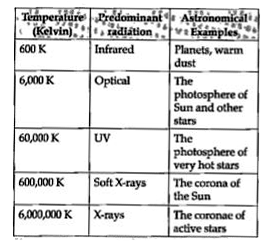
Each element in the periodic table can appear in gaseous form and produce its own spectrum unique to that element. Hydrogen will not look like Helium, which will not look like carbon which will not look like iron....and soon. Astrophysists can identify what kinds of materials are present in stars from the analysis of star's spectra. This type of study is called astronomical spectroscopy. The science of spectroscopy is quite sophisticated. From spectrum lines analysis astrophysists can determine not only the element, but the temperature and density of that element in the star. The spectral line also can tell us about any magnetic field of the star. The width of the line can tell us how fast the material is moving. We can learn about winds in stars from this. The shifting of spectral liens shift back and forth indicates that the star may be orbiting another star. The following table shows a rough guide for the relationship between the temperature of a star and the electromagnetic spectrum.

If the spectrum of a star is red or blue shifted, then it can be used to infer its velocity along the line of sight. Edwin Hubble observed that more distant galaxies tended to have more red shifted spectra. This establishes the theory of expansion of the universe.
The lines in a star's spectrum is found to shift back and forth. What conclusion may be drawn from this observation?

A

The star may be orbiting another star

B

There may be a storm in the star

C

The star may be rotating at a very high speed

D

None of the above

Text Solution

Verified by Experts

The correct Answer is:

A

The shifting of spectral lines shift back and forth indicates that the star may be orbiting another star.
Promotional Banner

Similar Questions

Explore conceptually related problems

Read the following text and answer the following questions on the basis of the same: Spectrum Analysis and Astronomy Each element in the periodic table can appear in gaseous form and produce its own spectrum unique to that element. Hydrogen will not look like Helium, which wil not look like carbon which will not look like iron....and soon. Astrophysists can identify what kinds of materials are present in stars from the analysis of star's spectra. This type of study is called astronomical spectroscopy. The science of spectroscopy is quite sophisticated. From spectrum lines analysis astrophysists can determine not only the element, but the temperature and density of that element in the star. The spectral line also can tell us about any magnetic field of the star. The width of the line can tell us how fast the material is moving. We can learn about winds in stars from this. The shifting of spectral liens shift back and forth indicates that the star may be orbiting another star. The following table shows a rough guide for the relationship between the temperature of a star and the electromagnetic spectrum. If the spectrum of a star is red or blue shifted, then it can be used to infer its velocity along the line of sight. Edwin Hubble observed that more distant galaxies tended to have more red shifted spectra. This establishes the theory of expansion of the universe. Which nature of spectrum establishes the theory of the expanding universe?

Read of the following text and answer the following questions on the basis of the same: Find the value of a

Read the following text and answer the following questions on the basis of the same: What is the expression for the polynomial?

Read the following text and answer the following questions on the basis of the same: What is the value of the polynomial if x=-1.

What does a neuron look like ?

What does a neuron look like?
