Home
Class 9
PHYSICS
A bus starts moving with an acceleration...

A bus starts moving with an acceleration `2 m//s^2`. A cyclist 96 m behind the bus starts simultaneously in the direction of the bus at a speed of 20 m/s. After what time the cyclist will overtake the bus?

A

16 s

B

8 s

C

12 s

D

4s

Text Solution

Verified by Experts

The correct Answer is:
C

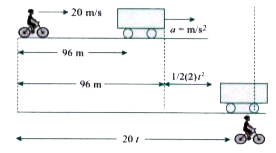
Say the cyclist catches the bus after time t. During t sec, bus travels a distance of `= 1/2 (2) t^2 = t^2m ` .
In the same time cyclist covers a distance 20 t.

So,
`96 + 1/2 a t^2 = 20 xx t`
`implies t^2 - 20 t + 96 = 0`
`implies t = (20 pm sqrt(400 - 4 xx 96))/(2 xx 1)`
`implies t = (20 pm 4)/2 = 12`
Promotional Banner

Topper's Solved these Questions

  • DESCRIPTION OF MOTION

    CENGAGE PHYSICS|Exercise CONSOLIDATED EXERCISE (MULTIPLE-CHOICE QUESTIONS WITH ONE OR MORE THAN ONE CORRECT ANSWER)|6 Videos
  • DESCRIPTION OF MOTION

    CENGAGE PHYSICS|Exercise CHALLENGING EXERCISE|6 Videos
  • DESCRIPTION OF MOTION

    CENGAGE PHYSICS|Exercise CONSOLIDATED EXERCISE (MATCH THE COLUMNS)|3 Videos
  • ELASTICITY

    CENGAGE PHYSICS|Exercise OLYMPIAD AND NTSE LEVEL EXERCISES|10 Videos

Similar Questions

Explore conceptually related problems

A bus starts moving with acceleration 2 ms^-2 . A cyclist 96 m behind the bus starts simultaneously towards the bus at a constant speed of 20 m//s . After what time will he be able to overtake the bus ?

A bus starts moving with acceleration 2m//s^(2) . A cyclist 96 m behind the bus starts moving simultaneously towards the bus a speed of 20 m/s. After what minimum time will he be able to overtake the bus?

A bus starts moving with acceleration 2 ms^(-2) . A cyclist 96 m behind the nus starts simultaneously towards the bus at a constant speed of 20 m s^(-1) After some time the bus will be left behind. If bus continues moving with the same acceelration, after what time from the begining, the bus will overtake the cyclist ?

A cyclist starts from rest and moves with a constant acceleration of 1 m//s^(2) . A boy who is 48 m behind the cyclist starts moving with a constant velocity of 10 m//s . After how much time the boy meets the cyclist?

A bus begins to move with an acceleration of 1 ms^(-1) . A man who is 1 48m behind the bus starts running at 10 ms^(-1) to catch the bus, the man will be able to catch the bus after .

A boy is moving with constant velocity 12 m//s . When he is 32 m behind a cyclist, the cyclist starts from rest and moves under constant acceleration 2 m//s^(2) . After how much time the boy meets the cyclist? Explain reason for two answers.

A bus starts from rest and moves whith acceleration a = 2 m/s^2 . The ratio of the distance covered in 6^(th) second to that covered in 6 seconds is

A student is running at her top speed of 5.0 m s^(-1) , to catch a bus, which is stopped at the bus stop. When the student is still 40.0m from the bus, it starts to pull away, moving with a constant acceleration of 0.2 m s^(-2) . a For how much time and what distance does the student have to run at 5.0 m s^(-1) before she overtakes the bus? b. When she reached the bus, how fast was the bus travelling? c. Sketch an x-t graph for bothe the student and the bus. d. Teh equations uou used in part (a)to find the time have a second solution, corresponding to a later time for which the student and the bus are again at thesame place if they continue their specified motions. Explain the significance of this second solution. How fast is the bus travelling at this point? e. If the student s top speed is 3.5 m s^(-1), will she catch the bus? f. What is the minimum speed the student must have to just catch up with the bus?For what time and what distance dies she have to run in that case?

CENGAGE PHYSICS-DESCRIPTION OF MOTION-CONSOLIDATED EXERCISE (MULTIPLE-CHOICE QUESTIONS WITH ONE CORRECT ANSWER)
  1. A stone when thrown with a velocity of 5 m/s attains a maximum height ...

    Text Solution

    |

  2. An ant moves along a circular track of 6 m radius such that the arc of...

    Text Solution

    |

  3. A ball is dropped from a balloon which is rising up with a speed of 2 ...

    Text Solution

    |

  4. If a car travels 30 m and 26 m in its 7^(th) and 6th second of its tra...

    Text Solution

    |

  5. If a ball is thrown upward with a velocity of 6 m/s. The maximum heigh...

    Text Solution

    |

  6. If a body is thrown in air with an angle with horizontal. Then the pat...

    Text Solution

    |

  7. A ball is thrown vertically upward in air. When the particle is at a h...

    Text Solution

    |

  8. Which of the graph shows that the particle is at rest .

    Text Solution

    |

  9. A particle travels half of the circle of radius r. Then the displaceme...

    Text Solution

    |

  10. A ball is dropped from a certain height to fall under gravity. After 1...

    Text Solution

    |

  11. The ratio of maximum height reached by two bodies projected vertically...

    Text Solution

    |

  12. Two trains 1000 m long are moving parallel to each other at a speed of...

    Text Solution

    |

  13. A car travels the first 1//3^(rd) distance at a speed of 30 km/h, the ...

    Text Solution

    |

  14. A bus starts moving with an acceleration 2 m//s^2. A cyclist 96 m behi...

    Text Solution

    |

  15. The velocity of car changes from 40 m/s to 10 m/s in 10 s. The acceler...

    Text Solution

    |

  16. Which of the graph shows a particle with retardation?

    Text Solution

    |

  17. Speed of two identical cars are u and 4u at the instant. The ratio of ...

    Text Solution

    |

  18. A ball is released from the top of a tower to height h. It takes T sec...

    Text Solution

    |

  19. A car is standing 100 m behind a bus. The bus and the car both start m...

    Text Solution

    |

  20. Which of the following is correct about the given graph?

    Text Solution

    |

