Home
Class 9
PHYSICS
A car weighs 1800 kg. The distance betwe...

A car weighs 1800 kg. The distance between its front and back axles is 1.8 m. Its centre of gravity is 1 m behind the front axle. The force exerted by the level ground on each front wheel and each back wheel is (Take `g : 10 ms^(-1)`)

A

4000 N on each front wheel, 5000 N on each back wheel

B

5000 N on each front wheel, 4000 N an each back wheel

C

4500N on each front wheel, 4500 N on each back wheel

D

3000 N on each front wheel, 6000 N on each back wheel

Text Solution

Verified by Experts

The correct Answer is:
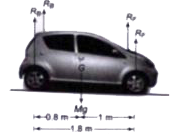
A

Here, mass of the car, M= 1800 kg
Distance between front and back axles = 1.8 m Distance of gravity G behind the front axle = 1 m
Let RF and RB be the forces exerted by the level ground on each front wheel and each back wheel.

For translational equilibrium,
`2R_(F) + 2R_(B) = Mg`
or `R_(F) + R_(B) = (Mg)/2 =(1800 xx 10)/2 = 9000 N`.....(i)
(As there are two front wheels and two back wheels) For rotational equilibrium about G
`(2R_(F))(1) =(2R_(B)) (0.8)`
`R_(F)/R_(B) = 0.8 = 8/10 = 4/5 rArr R_(F) = 4/5 R_(B)`........(ii)
Substituting this in Eq. (i), we get
`4/5 R_(B) + R_(B) = 9000` or `9/5 R_(B)= 9000`
`R_(B) = (900 xx 5)/9 = 5000 N`
`therefore R_(F) = 4/5 R_(B) = 4/5 xx 5000 N = 4000 N`
Promotional Banner

Topper's Solved these Questions

  • STATICS

    CENGAGE PHYSICS|Exercise CHALLENGING EXERCISE |5 Videos
  • SOUND

    CENGAGE PHYSICS|Exercise OLYMPIAD AND NTSE LEVEL EXERCISE|10 Videos
  • UNITS AND MEASUREMENT

    CENGAGE PHYSICS|Exercise OLYMPIAD AND NTSE LEVEL EXERCISES |8 Videos

Similar Questions

Explore conceptually related problems

A car weighs 1800 kg . The distance between its front and back axles is 1.8 m . Its centre of gravity is 1.05 m behind the front axle. Determine the force exerted by the level ground on each front wheel and each back wheel.

A uniform rod of length 1m having mass 1 kg rests against a smooth wall at an angle of 30^(@) with the ground. Calculate the force exerted by the ground on the rod. Take g = 10 ms^(-2) .

An iron nail of mass 0.2 kg is dropped from a height h=1m from level of a sand bed. If it penetrates through a distance x=0.1m in the sand before coming to rest. Calculate the average force exerted by the sand on the nail. (Take g= 10m//s^(2) )

The tricycle weighing 20 kg has a small wheel symmmetrically placed 1m behind the two large wheels, which are also 1m apart. If the center of gravity of machine is at a horizontal distance of 25 cm behind the front wheels and the rider whose weight is 40 kg is 10 cm behind the front wheels. Then, the thrust on each front wheel is

There is a man of mass 100 kg sitting on a motorbike of mass 150 kg. The distance of the axles of the wheels (wheelbase) is 1 . 5 m, the common mass center of the man and the motorbike is at a 1 m height above the ground level, and at a 0.6 m distance from the vertical line going through the rear axle. What acceleration is needed to lift the front wheel?

There is a man of mass 100 kg sitting on a motorbike of mass 150 kg. The distance of the axles of the wheels (wheelbase) is 1 . 5 m, the common mass center of the man and the motorbike is at a 1 m height above the ground level, and at a 0.6 m distance from the vertical line going through the rear axle. What normal force is exerted on the real wheel by the ground, when the motorbike starts off with an acceleration of a = 2 m//s^(2) ?

The centre of gravity of a car is at a height h and the distance between its wheel is 2a. The car moves on a level curve of radius r with speed v . Let N_(1) and N_(2) be the normal reactions on the inner and outer wheels of the car. Then

