Home
Class 9
MATHS
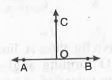
If ray OC stands on line AB such that an...

If ray OC stands on line AB such that `angleAOC = angleBOC` (see fig.
) show that `angleAOC = 90^@`.

Promotional Banner

Topper's Solved these Questions

  • LINES AND ANGLES

    MODERN PUBLICATION|Exercise EXERCISE|151 Videos
  • LINEAR EQUATIONS IN TWO VARIABLES

    MODERN PUBLICATION|Exercise EXERCISE|151 Videos
  • MODEL TEST PAPER 1

    MODERN PUBLICATION|Exercise EXAMPLE|9 Videos

Similar Questions

Explore conceptually related problems

In the fig. show that AB||EF

D is a point on side BC of Delta ABC such that AD = AC (see Fig. 7.47). Show that AB > AD.

In an isosceles triangle ABC with AB = AC, D and E are points on BC such that BE = CD (see Fig. 7.29). Show that AD = AE.

In given fig. Rays OA, OB, OC, OD and OE have common initial point O. Show that angleAOB + angleBOC + angleCOD + angleDOE + angleEOA = 360^@ .

In given fig. , Rays OA, OB, OC, OD and OE have common initial point O. Show that angleAOB + angleBOC + angleCOD + angleDOE + angleEOA = 360^@ .

In fig. AB and CD intersect each other at point O. If angleAOC + angleBOE = 70^@ and angleBOD = 40^@ then the value of angleBOE and reflex angleCOE are :

In fig. AB and CD intersect each other at point O. If angleAOC + angleBOE = 70^@ and angleBOD = 40^@ then the value of angleBOE and reflex angleCOE are :

In the given Fig , Sides AB and AC of a DeltaABC are produced to E and D respectively. If respective bisectors BO and CO of angleCBE and angleBCD intersect each other at point O, prove that angleBOC = 90^@-1/2 angleBAC .

In the given Fig , Sides AB and AC of a DeltaABC are produced to E and D respectively. If respective bisectors BO and CO of angleCBE and angleBCD intersect each other at point O, prove that angleBOC = 90^@-1/2 angleBAC .

AB and CD are respectively the smallest and longest sides of a quadrilateral ABCD (see Fig. 7.50). Show that angle A > angle C and angle B > angle D .

MODERN PUBLICATION-LINES AND ANGLES-EXERCISE
  1. If ray OC stands on line AB such that angleAOC = angleBOC (see fig. )...

    Text Solution

    |

  2. Find the complement of each of the following angles: 25^@

    Text Solution

    |

  3. Find the complement of each of the following angles: 40^@

    Text Solution

    |

  4. Find the complement of each of the following angles: 58^@

    Text Solution

    |

  5. Find the complement of each of the following angles: 77^@

    Text Solution

    |

  6. Find the supplement of each of the following angles: 54^@

    Text Solution

    |

  7. Find the supplement of each of the following angles: 138^@

    Text Solution

    |

  8. Find the supplement of each of the following angles: 14^@

    Text Solution

    |

  9. Find the supplement of each of the following angles: 172^@

    Text Solution

    |

  10. Find the measure of an angle, which is 36^@ is less than its complemen...

    Text Solution

    |

  11. Find the measure of an angle, which is 36^@ more than its complement.

    Text Solution

    |

  12. Find the measure of an angle which is 36^@ is less than its suplement.

    Text Solution

    |

  13. Find the measure of an angle, which is 36^@ is less than its complemen...

    Text Solution

    |

  14. If the angles (2x-10)^@ and (x-5)^@ are complementary angles. Find x.

    Text Solution

    |

  15. Find the measure of angle, if seven times its complement is 10^@ less ...

    Text Solution

    |

  16. If an angle differs from its complement by 10^@, find its angle.

    Text Solution

    |

  17. An angle is 14^@ more than its complementary angle. What is its measur...

    Text Solution

    |

  18. Find the angle which is double its complement.

    Text Solution

    |

  19. Find the angles which is five times its supplement.

    Text Solution

    |

  20. Two complementary angles are in the ratio of 4:5. find the angles.

    Text Solution

    |

  21. Two supplementary angles are in the ratio 4:5. find the angles.

    Text Solution

    |

