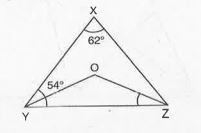
 `angleX = 62^@`, `angleXYZ = 54^@`. If YO and ZO are the bisectors of `angleXYZ` and `angleXZY` respectively of `DeltaXYZ`, find `angleOZY` and `angleYOZ`.


Topper's Solved these Questions
Similar Questions
Explore conceptually related problems
MODERN PUBLICATION-LINES AND ANGLES-EXERCISE
- In the given fig. angleX = 62^@, angleXYZ = 54^@. If YO and ZO are t...
Text Solution
|
- Find the complement of each of the following angles: 25^@
Text Solution
|
- Find the complement of each of the following angles: 40^@
Text Solution
|
- Find the complement of each of the following angles: 58^@
Text Solution
|
- Find the complement of each of the following angles: 77^@
Text Solution
|
- Find the supplement of each of the following angles: 54^@
Text Solution
|
- Find the supplement of each of the following angles: 138^@
Text Solution
|
- Find the supplement of each of the following angles: 14^@
Text Solution
|
- Find the supplement of each of the following angles: 172^@
Text Solution
|
- Find the measure of an angle, which is 36^@ is less than its complemen...
Text Solution
|
- Find the measure of an angle, which is 36^@ more than its complement.
Text Solution
|
- Find the measure of an angle which is 36^@ is less than its suplement.
Text Solution
|
- Find the measure of an angle, which is 36^@ is less than its complemen...
Text Solution
|
- If the angles (2x-10)^@ and (x-5)^@ are complementary angles. Find x.
Text Solution
|
- Find the measure of angle, if seven times its complement is 10^@ less ...
Text Solution
|
- If an angle differs from its complement by 10^@, find its angle.
Text Solution
|
- An angle is 14^@ more than its complementary angle. What is its measur...
Text Solution
|
- Find the angle which is double its complement.
Text Solution
|
- Find the angles which is five times its supplement.
Text Solution
|
- Two complementary angles are in the ratio of 4:5. find the angles.
Text Solution
|
- Two supplementary angles are in the ratio 4:5. find the angles.
Text Solution
|