

Home
Class 9
MATHS
Line l is the bisector of an angle angle...

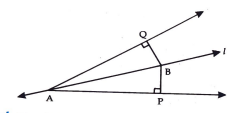
Line l is the bisector of an angle `angleA` and B is any point on l. BP and BQ are perpendiculars from B to the arms of `angleA` show that:
BP=BQ or B is equidistant from the arms of `angleA`

Promotional Banner

Topper's Solved these Questions

  • TRIANGLES

    MODERN PUBLICATION|Exercise EXERCISE|98 Videos
  • SURFACE AREAS AND VOLUMES

    MODERN PUBLICATION|Exercise EXERCISE|228 Videos

Similar Questions

Explore conceptually related problems

Line l is the bisector of an angle angleA and B is any point on l. BP and BQ are perpendiculars from B to the arms of angleA show that: triangleAPBequivtriangleAQB

Line l is the bisector of an angle angle A and B is any point on l. BP and BQ are perpendiculars from B to the arms of angle A (see Fig. 7.20). Show that: (i) triangle APB cong triangle AQB (ii) BP = BQ or B is equidistant from the arms of angle A .

AB is a line segment and line l is its perpendicular bisector. If a point P lies on l, show that P is equidistant from A and B.

Two lines l and m are intersect at the point O is a point on a line n passng through the passed O such that P is equidistant from l and m. find than n is the bisector of the angle formed by l and m.

Force on a charge in electric and magnetic fields A charge particle follows a parabolic path in a uniform electric field and a charged particel moving in a uniform magnetic field has two kinds of motions lnear motion in the direction of magnetic field and circular motion in a plane perpendicular to the magnetic field. when charge q is moving perpendicular to the magnetic field B, the radius of the circular path is r=(mv)/(Bq) . If v and B makes an angle theta , then r=(mvsintheta)/(Bq) , and the time period T=(2pim)/(Bq) . If an electron and a proton having same momenta enter perpendicular to a magnetic field, then

Force on a charge in electric and magnetic fields A charge particle follows a parabolic path in a uniform electric field and a charged particel moving in a uniform magnetic field has two kinds of motions lnear motion in the direction of magnetic field and circular motion in a plane perpendicular to the magnetic field. when charge q is moving perpendicular to the magnetic field B, the radius of the circular path is r=(mv)/(Bq) . If v and B makes an angle theta , then r=(mvsintheta)/(Bq) , and the time period T=(2pim)/(Bq) . The time period of a charged particle undergoing a circular motion in uniform magnetic field is independent of its

Force on a charge in electric and magnetic fields A charge particle follows a parabolic path in a uniform electric field and a charged particel moving in a uniform magnetic field has two kinds of motions lnear motion in the direction of magnetic field and circular motion in a plane perpendicular to the magnetic field. when charge q is moving perpendicular to the magnetic field B, the radius of the circular path is r=(mv)/(Bq) . If v and B makes an angle theta , then r=(mvsintheta)/(Bq) , and the time period T=(2pim)/(Bq) . When a charged particle q is moving with velocity vecv in a magnetic field vecB , the force is non-zero. It means.

Force on a charge in electric and magnetic fields A charge particle follows a parabolic path in a uniform electric field and a charged particel moving in a uniform magnetic field has two kinds of motions lnear motion in the direction of magnetic field and circular motion in a plane perpendicular to the magnetic field. when charge q is moving perpendicular to the magnetic field B, the radius of the circular path is r=(mv)/(Bq) . If v and B makes an angle theta , then r=(mvsintheta)/(Bq) , and the time period T=(2pim)/(Bq) . Under the influenece of a uniform magnetic field, a charged particles is moving in a circle of radius r with speed v. The time period of motion.

What are the points on X-axis whose perpendicular distance from the straight line x/a+y/b=1.

If perpendiculars from any point within an angle on its forms arms are congruent prove that it lies on the bisector of that angle.

MODERN PUBLICATION-TRIANGLES-EXERCISE
  1. Line l is the bisector of an angle angleA and B is any point on l. BP ...

    Text Solution

    |

  2. PQR is a triangle in which PQ=PR and S is any point on the side PQ. Th...

    Text Solution

    |

  3. In an isosclees triangle ABC, with AB = AC, the bisectors of angleB an...

    Text Solution

    |

  4. P is a point on the bisector of an angle angleABC. If the line through...

    Text Solution

    |

  5. ABC is a right angled triangle in which angleA = 90^@ and AB = AC. Fin...

    Text Solution

    |

  6. In the fig. RT=TS, angle1=2angle2 and angle4=2angle3. Prove that trian...

    Text Solution

    |

  7. In the fig AB=CD and AD=BC. Prove that triangleADCequivtriangleCBA

    Text Solution

    |

  8. In trianglePQR, S is the point on the side QR. Prove that PQ+QR+RP>2PS

    Text Solution

    |

  9. In the given fig. O is the point of each of the line segment AB and CD...

    Text Solution

    |

  10. In the given figure PA bot AB, QB bot AB and PA=QB intersects AB at O,...

    Text Solution

    |

  11. In the fig. X and Y are respectively two points on equal sides AB and ...

    Text Solution

    |

  12. In the fig. C is the mid point of AB. If angleDCA=angleECB and angleDB...

    Text Solution

    |

  13. In the fig. BAbotAC and DEbotEF such that BA=DE and BF=DC. Prove that ...

    Text Solution

    |

  14. In the fig. AD is a median of triangleABC. If BL and CM are drawn perp...

    Text Solution

    |

  15. In the fig. triangle AB=AC and bisectors of angleB and angleC meet at ...

    Text Solution

    |

  16. In the fig, PQR is an equilateral triangle and QRST is a square. Prove...

    Text Solution

    |

  17. In the fig, PQR is an equilateral triangle and QRST is a square. Prove...

    Text Solution

    |

  18. Prove that the median from the vertex of an isosceles triangle is the ...

    Text Solution

    |

  19. In the fig. ABCD is square and P is a point on such that PB=PD. Prove ...

    Text Solution

    |

  20. In the fig. :ABCD is a quadrilateral in which AD=AB and BC=DC. Prove t...

    Text Solution

    |

  21. In the fig. :ABCD is a quadrilateral in which AD and BC=DC. Prove that...

    Text Solution

    |