Home
Class 9
MATHS
Over the apst 200 working days, the numb...

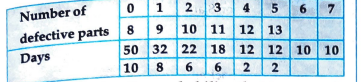
Over the apst 200 working days, the number of defective parts produced by a machine is given in the following table:
Determine the probability that tommorow's output will have

at least one defective part.

Promotional Banner

Topper's Solved these Questions

  • PROBABILITY

    MODERN PUBLICATION|Exercise EXERCISE|45 Videos
  • POLYNOMIALS

    MODERN PUBLICATION|Exercise EXERCISE|247 Videos
  • QUADRILATERALS

    MODERN PUBLICATION|Exercise EXERCISE|133 Videos

Similar Questions

Explore conceptually related problems

Over the apst 200 working days, the number of defective parts produced by a machine is given in the following table: Determine the probability that tommorow's output will have more than 13 defective parts.

Over the apst 200 working days, the number of defective parts produced by a machine is given in the following table: Determine the probability that tommorow's output will have not more than 5 defective parts.

Over the apst 200 working days, the number of defective parts produced by a machine is given in the following table: Determine the probability that tommorow's output will have no defective part.

An insurance company selected 2000 drivers at random (i.e., without any preference of one driver over another) in a particular city to find a relationship between age and accidents. The data obtained are given in the following table: Find the probabilities of the following events for a driver chosen at random from the city: having no accidents in one year.

An insurance company selected 2000 drivers at random (i.e., without any preference of one driver over another) in a particular city to find a relationship between age and accidents. The data obtained are given in the following table: Find the probabilities of the following events for a driver chosen at random from the city: being 30-50 years of age and having one or more accidents in a year.

An insurance company selected 2000 drivers at random (i.e., without any preference of one driver over another) in a particular city to find a relationship between age and accidents. The data obtained are given in the following table: Find the probabilities of the following events for a driver chosen at random from the city: being 18-29 years of age and having exactly 3 accidents in one year.

In a hospital, there are 5 dialysis machine. The chance of any one of them being defective during a day is 1/10 . Find the probability that two machines will be out of order on the same day. What is the probability that at least one machine is in working order? Is this situation alright for a small hospital?

A manufacturer has three machines I, II and III installed in his factory. Machines I and II are capable of being operated for at most 12 hours whereas machine III must be operated for at least 5 hours a day. She produces only two items M and N each on the three machines are given in the following table: SHe makes a profit of Rs 600 and Rs 400 on items M and N respectively. How many of each item should she produce so as to maximise her profit assuming that she can sell all the items that she produced? What will be the maximum Profit?

A factory has two machines A and B. Past record shows that machine A produced 60% of the items of output and machine B produced 40% of the items. Further, 2% of the items produced by machine A and 1% produced by machine B were defective. All the items are put into one stockpile and then one item is chosen at random from this and is found to be defective. What is the probability that it was produced by machine B?

Three machines E_1, E_2, E_3 in a certain factory produce 50%, 25% and 25% respectively of the total daily output of electric tubes. It is known that 4% of the tubes produced by each of machines E_1 and E_2 are defective, and that 5% of those produced on E_3 are defective. If one tube is picked up at random from a day's production, calculate the probability that it is defective.

MODERN PUBLICATION-PROBABILITY-EXERCISE
  1. Over the apst 200 working days, the number of defective parts produced...

    Text Solution

    |

  2. Define a trial.

    Text Solution

    |

  3. Define a event.

    Text Solution

    |

  4. Define an elementary event.

    Text Solution

    |

  5. Define the probability of an event.

    Text Solution

    |

  6. When a die is thrown, what are the six possible outcomes?

    Text Solution

    |

  7. Describe two events that are sure to happen.

    Text Solution

    |

  8. Describe two events that are impossible to happen.

    Text Solution

    |

  9. A fair coins is tossed 60 times and it came up with tails 27 times. Fi...

    Text Solution

    |

  10. A die is thrown 100 times if the probability of getting an even number...

    Text Solution

    |

  11. A coin is tossed 50 times and the tail appears 28 times. In a single t...

    Text Solution

    |

  12. True/False: Probability of a sure event is 0.

    Text Solution

    |

  13. True/False: Probability of an impossible event is 1.

    Text Solution

    |

  14. True/False: If E is an event, then 0 le P(E) le1

    Text Solution

    |

  15. True/False: If E is an event, the P(E) + P(notE) = 0

    Text Solution

    |

  16. True|false: use the theoretical probability of an event 'E' is 0.47, ...

    Text Solution

    |

  17. Can the experiment probability of an event be a negative number? If no...

    Text Solution

    |

  18. True/False: The experimental probability of an event cannot be great...

    Text Solution

    |

  19. True/False: Out of 35 students participating in a debate 10 are boys...

    Text Solution

    |

  20. True/False: The probability of losing a game is 0.7. The probability...

    Text Solution

    |

  21. True/False: In a one-day cricket match, a batsman hits the boundary ...

    Text Solution

    |