Home
Class 9
MATHS
Over the apst 200 working days, the numb...

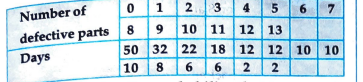
Over the apst 200 working days, the number of defective parts produced by a machine is given in the following table:
Determine the probability that tommorow's output will have

not more than 5 defective parts.

Promotional Banner

Topper's Solved these Questions

  • PROBABILITY

    MODERN PUBLICATION|Exercise EXERCISE|45 Videos
  • POLYNOMIALS

    MODERN PUBLICATION|Exercise EXERCISE|247 Videos
  • QUADRILATERALS

    MODERN PUBLICATION|Exercise EXERCISE|133 Videos

Similar Questions

Explore conceptually related problems

Over the apst 200 working days, the number of defective parts produced by a machine is given in the following table: Determine the probability that tommorow's output will have more than 13 defective parts.

Over the apst 200 working days, the number of defective parts produced by a machine is given in the following table: Determine the probability that tommorow's output will have no defective part.

Over the apst 200 working days, the number of defective parts produced by a machine is given in the following table: Determine the probability that tommorow's output will have at least one defective part.

There are 5% defective items in a large bulk of items. What is the probability that a sample of 10 items will include not more than one defective item?

An insurance company selected 2000 drivers at random (i.e., without any preference of one driver over another) in a particular city to find a relationship between age and accidents. The data obtained are given in the following table: Find the probabilities of the following events for a driver chosen at random from the city: having no accidents in one year.

An insurance company selected 2000 drivers at random (i.e., without any preference of one driver over another) in a particular city to find a relationship between age and accidents. The data obtained are given in the following table: Find the probabilities of the following events for a driver chosen at random from the city: being 30-50 years of age and having one or more accidents in a year.

An insurance company selected 2000 drivers at random (i.e., without any preference of one driver over another) in a particular city to find a relationship between age and accidents. The data obtained are given in the following table: Find the probabilities of the following events for a driver chosen at random from the city: being 18-29 years of age and having exactly 3 accidents in one year.

An Organisation selected 2400 families at random and surveyed them to determine a relationship between income level and the number of vehiclesin a family. The information gathered is listed in the table below : Suppose a family is chosen. Find the probability that the family chosen is : not more than 1 vehicle.

Two dice are thrown simultaneously 500 ties. Each time the sum of two numbers appearing on their tops is noted and recorded as given in the following table: If the dice are thrown once more, what is the probability of getting a sum: less than or equal to 5?

MODERN PUBLICATION-PROBABILITY-EXERCISE
  1. Over the apst 200 working days, the number of defective parts produced...

    Text Solution

    |

  2. Define a trial.

    Text Solution

    |

  3. Define a event.

    Text Solution

    |

  4. Define an elementary event.

    Text Solution

    |

  5. Define the probability of an event.

    Text Solution

    |

  6. When a die is thrown, what are the six possible outcomes?

    Text Solution

    |

  7. Describe two events that are sure to happen.

    Text Solution

    |

  8. Describe two events that are impossible to happen.

    Text Solution

    |

  9. A fair coins is tossed 60 times and it came up with tails 27 times. Fi...

    Text Solution

    |

  10. A die is thrown 100 times if the probability of getting an even number...

    Text Solution

    |

  11. A coin is tossed 50 times and the tail appears 28 times. In a single t...

    Text Solution

    |

  12. True/False: Probability of a sure event is 0.

    Text Solution

    |

  13. True/False: Probability of an impossible event is 1.

    Text Solution

    |

  14. True/False: If E is an event, then 0 le P(E) le1

    Text Solution

    |

  15. True/False: If E is an event, the P(E) + P(notE) = 0

    Text Solution

    |

  16. True|false: use the theoretical probability of an event 'E' is 0.47, ...

    Text Solution

    |

  17. Can the experiment probability of an event be a negative number? If no...

    Text Solution

    |

  18. True/False: The experimental probability of an event cannot be great...

    Text Solution

    |

  19. True/False: Out of 35 students participating in a debate 10 are boys...

    Text Solution

    |

  20. True/False: The probability of losing a game is 0.7. The probability...

    Text Solution

    |

  21. True/False: In a one-day cricket match, a batsman hits the boundary ...

    Text Solution

    |