Home
Class 12
CHEMISTRY
Alcohols (R-OH), phenols (Ar-OH) and ca...

Alcohols (R-OH), phenols (Ar-OH) and carboxylic acids (R-COOH) can undergo ionization of O-H bond to give away proton `H^(+)`, yet they have different `pK_4` values, which are 16, 10 and 4.5 respectively. Explain.

Text Solution

Verified by Experts
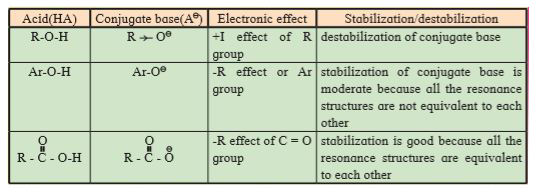
`pK_a` value is indicative of acid strength. Lower the `pK_a` value stronger the acid. Alcohols, phenols and carboxylic acids, all involve ionization of an O-H bond. But their different `pK_a` values indicate that their acid strength are different. This is because the resulting conjugate bases are stabilized to different extent.

As the conjugate base of carboxylic acid is best stabilized, among the three, carboxylic acids are strongest and have the lowest `pK_a` value. As conjugate base of alcohols is destabilized, alcohols are weakest acids and have highest `pK_a` value. As conjugate base of phenols is moderately stabilized phenols are moderately acidic and have intermediate `pK_a` value.
Promotional Banner

Similar Questions

Explore conceptually related problems

The ionization'constant of an acid K_a , is the measure of strength of an acid.The K_a values of acetic acid, hypochlorous acid and formic acid are 1.74 xx 10^-5, 3.0 xx-10^-8 and 1.8 xx10^-4 respectively. Which of the following orders of pH of 0.1 mol dm-3solutions,of these acids is correct?

HCI is added to a hydrocarbon 'A' (C_4H_8) to give a compound 'B'which on hydrolysis with aqueous alkali forms tertiary alcohol 'C' (C_4H_10O) .Identify 'A','B' and'C'.

An organic compound P has molecular formula C_(2)H_(4) . On reduction, it gives another compound Q with molecular formula C_(2)H_(6). Q reacts with chlorine in the presence of sunlight to give R having molecular formula C_(2)H_(5)Cl. Identify P, Q and R.

K_H value for Ar(g), CO_2(g), HCHO(g) and CH_4(g) are 40.39, 1.67, 1.83 xx 10^-5 and 0.413 respectively. Arrange these gases in the order of their increasing solubility.

An organic compound P has molecular formula C_(2)H_(4) . On reduction, it gives another compound Q with molecular formula C_(2)H_(6). Q reacts with chlorine in the presence of sunlight to give R having molecular formula C_(2)H_(5)Cl. ii. Write the chemical equation for the conversion of P to Q.

Ethyl acetate is fomred by the reactoin between ethanol and acetic acid and the equilibrium is represented as: CH_3COOH(L) + C_2H_5OH(l) hArr CH_3COOC_2H_5(l) + H_2O(l) Starting with 0.5 mol of ethanol and 1.0 mol of acetic acid and maintaining it at 293 K,0.214 mol of ethhyl acetate is found after sometime.Has equilibrium been reached ?

In the reaction, 4Zn + NO_(3)^(-) + 7H_(2)O rarr 4Zn^(2+) + NH_(4)^(+) + 10OH^(-) , the substance which gets reduced is "______________" .

Following are atomic masses of a few elements in Dalton and the molecular formulae of some compounds. Deduce the molecular masses of those compounds. Atomic masses H(1), (16), N(14), C(12), K(39), S(32) Ca(40), Na(23), CI(35.5), Mg(24). Al(27) Molecular formulae → NaCI, KNO,H2O, AICI3, Ca(OH), MgO, H2SO4, NaOH​Mg(24). Al(27) Molecular formulae → NaCI, MOCI,, KNO,H,O, AICI, Ca(OH),, MgO, H,SO, HINO, NaOH​

Given: C_(("Graphite"))+O_(2(g))toCO_(2(g)), Delta_rH^@=-393.5 kJ mol^-1 H_(2(g))+1/2 O_(2(g)) to H_2O_((l)), Delta_rH^@=-285.8 kJ mol^-1 CO_(2(g))+2H_2O_((l)) to CH_(4(g))+2O_(2(g)), Delta_r H^@=+890.3 kJ mol^-1 Based on the above thermochemical equations, the value of Delta_r H^@ at 298 K for the reaction C_(("graphite")) + 2H_(2(g)) to CH_(4(g)) will be _________ .

