Home
Class 11
BIOLOGY
Observe the following diagrams of invert...

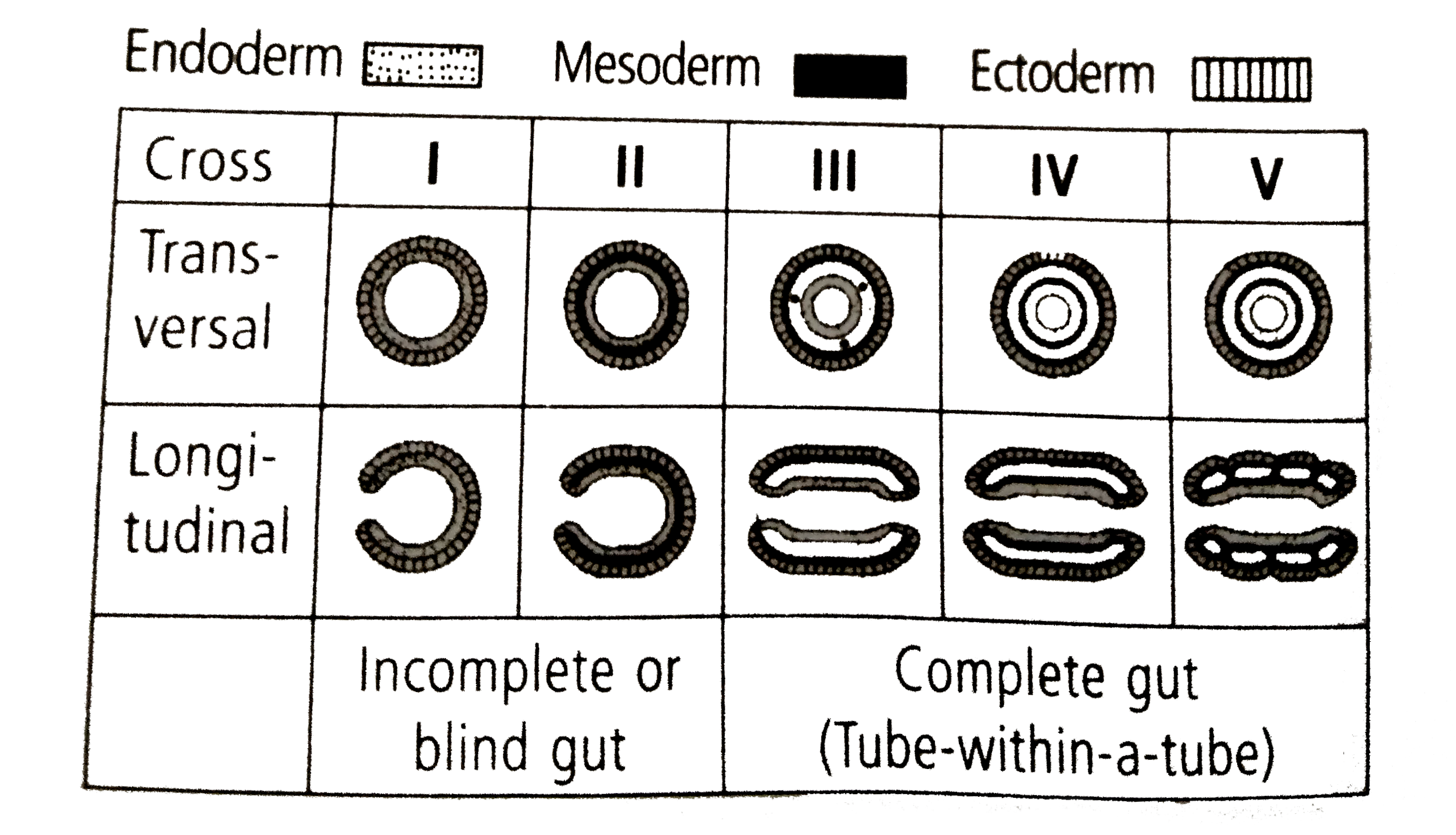
Observe the following diagrams of invertebrates embryos illustrating the characteristics of the body plan.
Reference

Select the correct sequence which corresponds to the phyla represented with I, II, III, IV and V.

A

`{:(" I"," II"," III"," IV"," V"),("Cnidaria","Platyhelminthes","Annelida","Nematoda","Arthropoda"):}`

B

`{:(" I"," II"," III"," IV"," V"),("Cnidaria","Platyhelminthes","Nematoda","Arthropoda","Annelida"):}`

C

`{:(" I"," II"," III"," IV"," V"),("Nematoda","Arthropoda","Platyhrlminthes","Cnidaria","Annelida"):}`

D

`{:(" I"," II"," III"," IV"," V"),("Annelida","Cnidaria","Arthropoda","Platyhrlminthes","Nematoda"):}`

Text Solution

Verified by Experts

The correct Answer is:

B

The embryo of animal I shows two germinal layers, ectoderm and mesoderm. This animal is diploblastic, it can be a poriferm and mesoderm. This animal is diploblastic, it can be a poriferan or cnidarian. The embroyos of all other animals have three germinal layers, the ectoderm, mesoderm and endoderm. These animals are triploblastic animals. They can be from Phylum Platyhelminthes to Phylum Mollusca. Embryos I and II have no coelom, III has pseudocoelom and IV and V have true coelom. Coelom is a fluid -filled cavity that forms the main body cavity of animals. it is formed by splitting of the mesoderm. Therefore, embryos I and II can be of poriferans, cnidarians, ctenophorans or platyhelminthes, embryo III is of nemathelminthes, whereas embryos of V shows internal divisions or segmentation in the body. Embryo V, thus is annelidan. So, we can conclude, embryo I is of cnidaria, embryo II is of platyhelminthes, embryo III is of namathelminthes, embryo IV is of arthropoda and embryo V is of annelida.
Promotional Banner

Similar Questions

Explore conceptually related problems

Identify the structure indicated by labels (i),(ii),(iii) and (iv) and select the correct option.

Given figure represents a pyramid of biomass in an aquatic ecosystem. Identify A and B and select the correct answer. (i) A is the crop which supporsts and B is the crop which is supported. (ii) A is the crop which is supported and B is the crop which supports. (iii) A is phytoplanktons and B is zooplanktons. (iv) A is zooplanktons and B is phytoplanktons.

Which of the following is/are not the characteristics of the Class Osteichthyes? (i) Body is streamlined and mouth is terminal. (ii) Gills are convered by operculum. (iii) Skin convered with cycloid and placoid scales. (iv) Many of them are viviparous.

(i) Thin thread like chromosomes with a beaded appearance (ii) Appearance of recombination nodules (iii) Formation of bivalents/tetrads (iv) Terminalisation of chiasmata (v) Appearance of chiasmata Arrange the given statements in the correct sequence of their occurrence during prophase I.

In pteridophytes, main plant body is _(i)__, which is __(ii)__ into true roots, stem and leaves fill the blanks in above statements and select the correct option

Define the following terms. (i) Genus (ii) Family (iii) Order (iv) Class (v) Phylum

Read the following statements regarding methanogens and select the correct option. (i) They are included in the group Archaebacteria. (ii) They are responsible for the production of biogas in gobar gas plants. (iii) They live in hot sulphur springs. (iv) They are strictly anaerobic.

Read the following statements and select the correct ones. (i) Increase in mass and increase in number of individuals are twin characteristics of growth. (ii) Metabolic reactions can be demonstrated outside the body in isolated cell-free systems. (iii) 'Response to stimuli' is a defining property of living organisms.

Select the correct statements regarding the characteristics of acquired immunity. (i) Cell-mediated immunity is responsible for acquired immunity. (ii) It produces a primary response of low intensity. (iii) Active and passive immunity are types of acquired immunity, (iv) Polymorphonuclear leucocytes and natural killer cells are involved in acquired immunity.

Arrange the following stages of fertilisation and early development into a proper sequence. I. Sperm entry II. Acrosomal reaction III. Karyogamy IV. Capacitation V. Cortical reaction
