Home
Class 11
BIOLOGY
The inhibitor which does not resemble th...

The inhibitor which does not resemble the substrate in structure and binds to the enzyme at site other than the active site is called

A

competitive inhibitor

B

non-competitive inhibitor

C

activator

D

substrate analogue.

Text Solution

Verified by Experts

The correct Answer is:
B

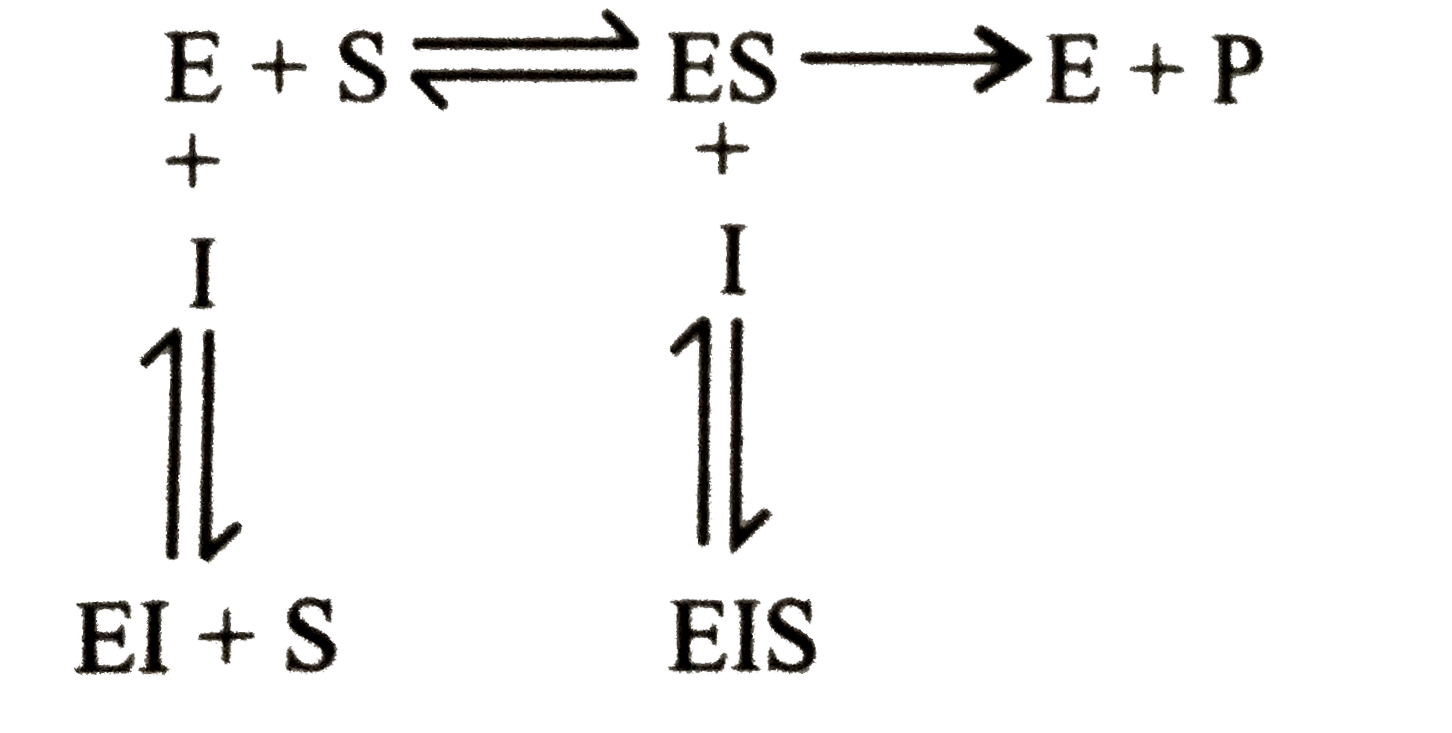
In non-competitve inhibition, the inhibitor binds at a site other than the active site ob the enzyme surface. This binding impairs the enzyme function. The inhibitor has no structural resemblance with the sunstrate. It does not interfere with the enzyme-substrate binding but the catalysis is prevented, possibly due to a distortion in the enzyme conformation. Non-competitive inhibition is usually irreversible because it cannot be overcome by increasing the substrate concentration. The inhibitor (l) generally binds with the enzyme as well as the ES complex. The overall relation in non.competitve inhibition is represented as :
Promotional Banner

Similar Questions

Explore conceptually related problems

The inhibitor which closely resembles the substrate in its molecular structure and inhibits the enzyme activity by biniding to the active site of the enzyme is called

Assertion : The inhibition of activity of succinic dehydrogenase by malonate which closely resembles the substrate succinate in structure is the example of competitive inbhibition. Reason : Competitive inhibition is the inhibition of enzyme activity when inhibitor closely resembles the substrate, in its molecular structre.

What are the forces involved in holding the drugs to the active site of enzymes ?

Answer the following in one word only. Genetic unit consisting of an operator, promoter, regulator and structural genes, which determines the presence of set enzymes that catalyze a particular set of chemical reactions is called.

Assterion : Each enzyme has a substrate binding site in its molecule which forms highly reactive enzyme-substrate complex. Reason : The enzyme-substrate complex is long-lived and dissociates into its product and unchanged enzyme.

Study the given data and answer the questions that follow. A sample of an enzyme called lactase was isolated from the intestinal lining of a calf. Assays were undertaken to evaluate the activity of the enzyme sample. The substrate of lactase is the disaccharide lactose. Lactase breaks a lactose molecule in two, producing a glucose molecule and a galactose molecule. Two assays were carried out. {:("Lactose concentration (% w/v)",15,15,15,15,15,15),("Concentration of enzyme smaple (%v/v)",0,5,10,15,20,25),("Reaction rate "mu"mole glucose "sec^(-1)mL^(-1),0,25,50,75,100,125):} {:("Lactose concentration (% w/v)",0,5,10,15,25,30),("Concentration of enzyme smaple (%v/v)",5,5,5,5,5,5),("Reaction rate "mu"mole glucose "sec^(-1)mL^(-1),0,15,25,35,40,40):} Which of the following statements can be concluded from the two assays ?

Study the given data and answer the questions that follow. A sample of an enzyme called lactase was isolated from the intestinal lining of a calf. Assays were undertaken to evaluate the activity of the enzyme sample. The substrate of lactase is the disaccharide lactose. Lactase breaks a lactose molecule in two, producing a glucose molecule and a galactose molecule. Two assays were carried out. {:("Lactose concentration (% w/v)",15,15,15,15,15,15),("Concentration of enzyme smaple (%v/v)",0,5,10,15,20,25),("Reaction rate "mu"mole glucose "sec^(-1)mL^(-1),0,25,50,75,100,125):} {:("Lactose concentration (% w/v)",0,5,10,15,25,30),("Concentration of enzyme smaple (%v/v)",5,5,5,5,5,5),("Reaction rate "mu"mole glucose "sec^(-1)mL^(-1),0,15,25,35,40,40):} Which of the following assays would you expect to have the highest reaction rate ?

