Home
Class 11
BIOLOGY
Given diagram shows variations in the am...

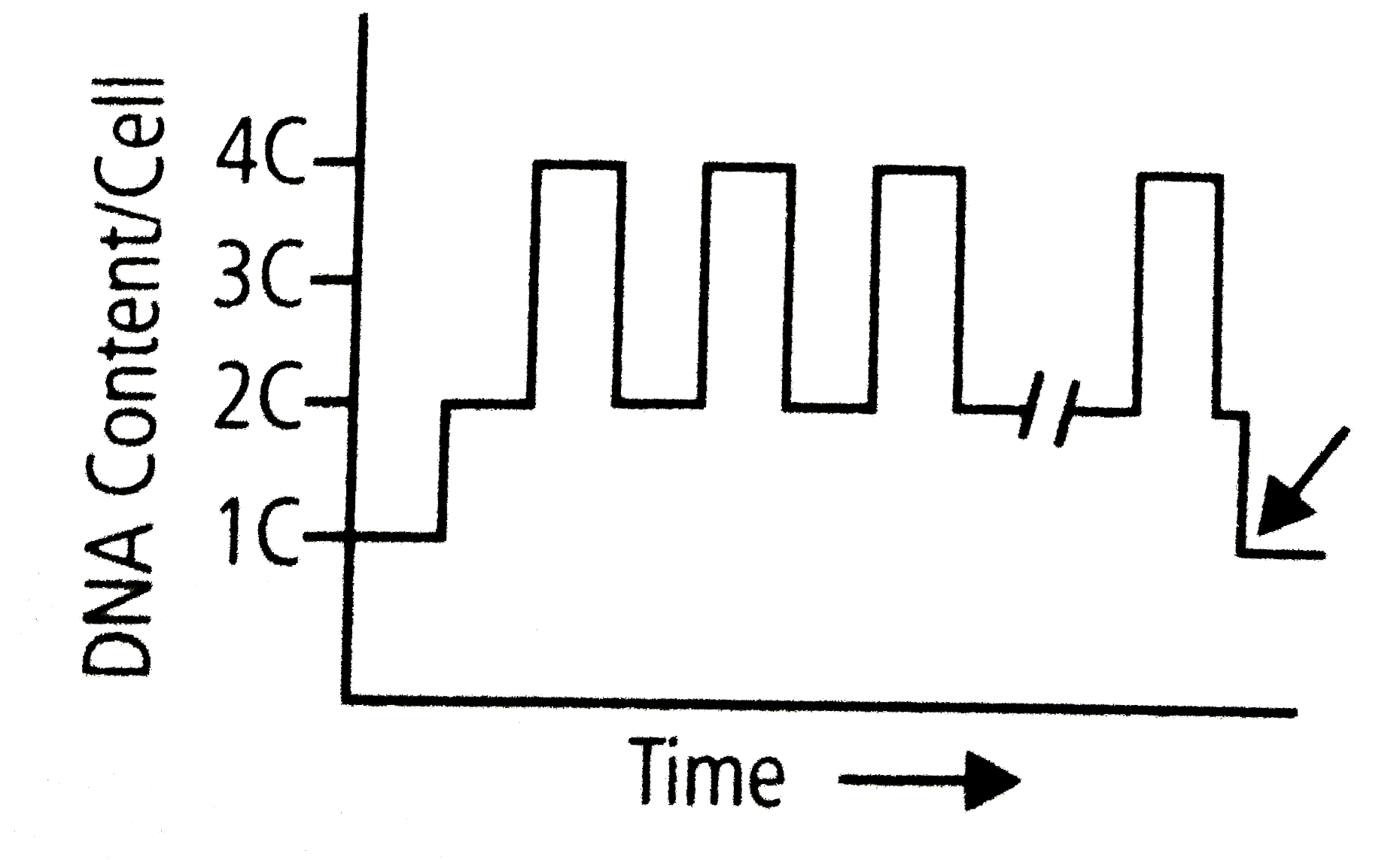
Given diagram shows variations in the amount of DNA of a developing eukaryote. What the arrow denotes?

A

First meiotic anaphase

B

Second meiotic anaphase

C

Mitotic anaphase

D

Mitotic telophase

Text Solution

Verified by Experts

The correct Answer is:

B

The given graph shows variations in the DNA content in the cells of a eukaryote. Hploid set of chromosomes 1C is present in gamete which on fertilisation with gamete of opposite sex acquires diploid set of chormosomes (2C) and transforms into embryo embryo develops and grows into diplid organism by multiple mitotic divisions. During sexual reproduction gamete formation takes place by meiotic divison under which amount of DNA (2C) increases to 4C during S phase, which in first meiotic divison reduces to half i.e., 2C, divided among two daughter cells wheresas chormosomal number reduces to half i.e., from 2n to n. During second meiotic division, the amont of DNA is further distriuted equally from each daughter cells from first meiotic division ) to two daughter cells. The second meiotic division is equational, therefore the number of chromosome remains the same as produced at the end of meiosis I. Thus at the end of meiosis-II, each of the four haploid daughter cells contains one copy of every chromosme in the set (1C), rather two.
Promotional Banner

Similar Questions

Explore conceptually related problems

Which of the following graphs shows the relative change in the amount of mitochondrial DNA of a cell undergoing mitosis?

The graph given below shows the variations in the population of producers, primary consumers and secondary consumers as well as the amount of dissolved mineral salts in a pond Which one of the following correctly matches each graph?

The diagram shows the flow of energy through an ecosystem. Which arrows represent the smallest amount of energy transferred between organisms and the largest amount of energy lost to the ecosystem?

The given diagram shows microsporangium of a mature anther. Identify A,B and C.

Refer to the given diagrams showing different types of syngamy and select the option that gives correct example of each of these.

The given diagram shows different stages of seed germination. Identify A,B,C and D and select the correct option.

The given diagram shows two plants of the same species. Identify the types of pollination indicated at P_(1),P_(2) and P_(3) .

Given diagram illustrates an evolutionary tree. Which of the following statements can be deduced from the given evolutionary tree? (i) The ancestral eukaryotes were anaerobic. (ii) All eukaryotes were anaerobic. (ii) All eukaryotes possess mitochondria. (iii) Eubacteria and Eukaryota have a common ancestor whereas Archebacteria have a unique and independent origin. (iv) Mitochondria and chloroplasts have similar genomes. (v) Mitochondria are presents in plants, animals and fungi. (vi) chloroplasts and mitochondria arose asendosymbionts. (vii) Fungi and animals lost chloroplasts during evolution.
