Home
Class 12
BIOLOGY
Biogas generation is a three stage anaer...

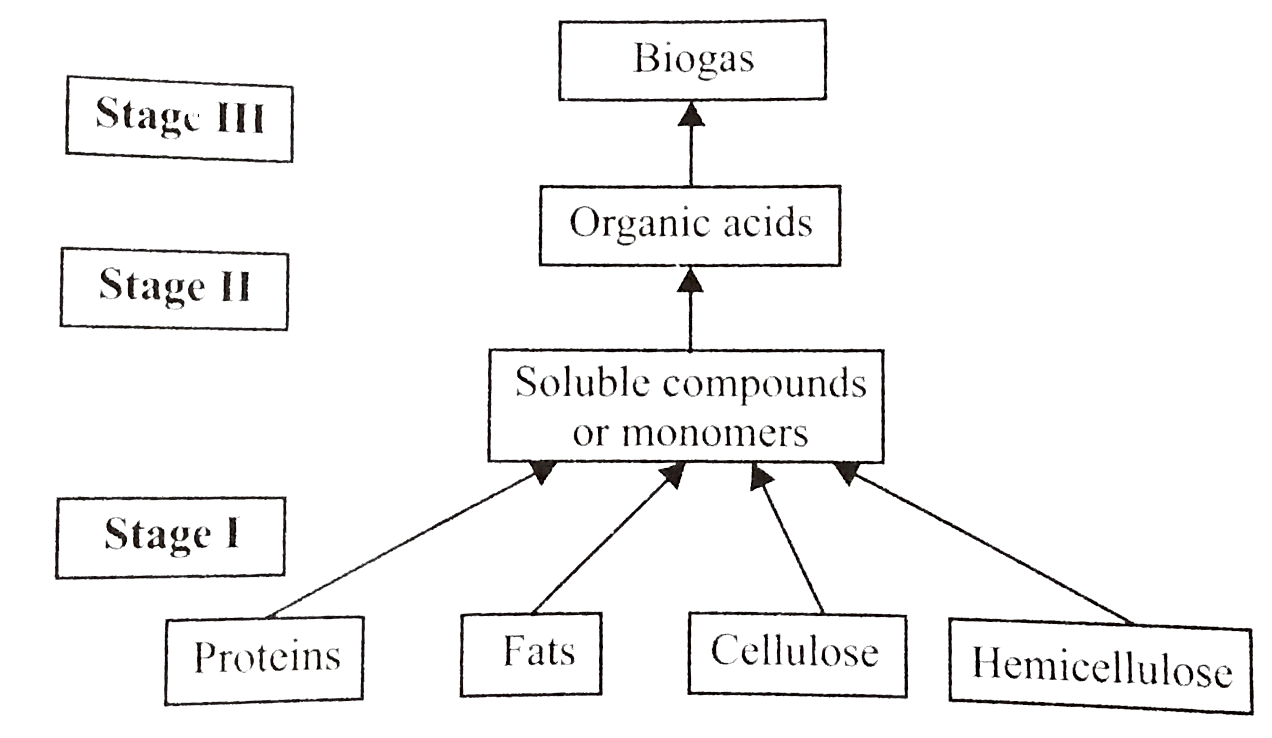
Biogas generation is a three stage anaerobic digestion of animal and other organic wastes. Study the following flow chart and select the correct option for stages I, II and III.

A

In stage -I, anaerobic microorganisms bring about enzymatic breakdown of complex organic compounds into simple soluble compounds or monomers

B

In stage -II, monomers are converted into organic acids by fermentation causing microbes

C

In stage-III, organic acids are acted upon by methanogenic bacteria to produce biogas

D

All of these

Text Solution

Verified by Experts

The correct Answer is:

D
Promotional Banner

Similar Questions

Explore conceptually related problems

Study the following flow chart and select the correct option for P, Q, R and S.

Go through the following flow chart for division of subphylum vertebrate. Fill the graph A, B, C and D and select the correct option.

Identify the structure indicated by labels (i),(ii),(iii) and (iv) and select the correct option.

The given flow chart depicts the steps to transfer a desirable gene of interest into a plant. Identify the missing steps (A,B and C) with regard ot following statements and select the correct option. (i) Joining of desirable gene to a suitable cloning vector using ligases to create a recombinant DNA molecule. (ii) Selection of transformed cells. (iii) Transferring the recombinant DNA molecules to teh target cells.

Fragmentation, leaching and catabolism are some of the important steps of decomposition. Study the following statements I , ii and iii regarding these and select the correct option. (i) Detritivores (e.g., earthworm) breakdown detritus into smaller particles. (ii) Water soluble inorganic nutrients go down into soil horizon and get precipitated as unavailable salts. (iii) Decomposers (e.g., bacteria and fungi) secrete digestive enzymes and degrade detritus into simpler inorganic substances.

(i) Thin thread like chromosomes with a beaded appearance (ii) Appearance of recombination nodules (iii) Formation of bivalents/tetrads (iv) Terminalisation of chiasmata (v) Appearance of chiasmata Identify the different stages with respect to the above given features and select the correct option.

If 2n=4, then identify the figures A,B and C, as per the following codes and select the correct option Anaphase of meiosis I=(i) Anaphase of mitosis =(ii) Anaphase meiosis II =(iii)

Match column I with column II and select the correct answer from the given codes. {:(Column I,Column II),(A. "The stage in which of physical treatment of sewage is done",(i)"Anaerobic digestion activated sludge and production of biogas"),(B."The stage in which biological treatment of sewage is done",(ii)"Activated sludge"),(C."Name of the sediment in primary treatment",(iii)"Aeration tanks"),(D."It is carried to aeration tanks from primary",(iv)"Primary effluent"),(E."Name of the sediment in secondary treatment",(v)"Primary sludge"),(F."site of flocs growth",(vi)"Secondary treatment"),(G."Function of sludge digester",(vii)"Primary treatment"):}

Given below are three statements regarding Aschelminthes. (i) They are bilaterally symmetrical and triploblastic. (ii) They are dioecious. (iii) All are plant or animal parasites. Select the option that has both the correct statemets.

Different cells have different sizes. Arrange the following cells in an ascending of their size and select the correct option. (i) Mycoplasma (ii) Ostrich egg (iii) Human RBCs (iv) Bacteria
