


Home
Class 8
MATHS
Take a squared paper and arrange 48 squa...

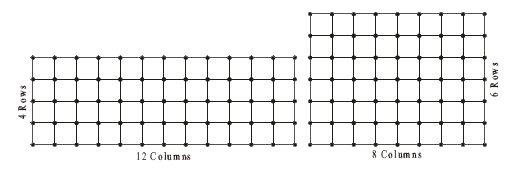
Take a squared paper and arrange 48 squares in different number of rows as shown below:


What do you observe? As R increases, C decreases
Is R and C inversely proportional to each other?

Promotional Banner

Similar Questions

Explore conceptually related problems

Take a squared paper and arrange 48 squares in different number of rows as shown below: What do you observe? As R increases, C decreases Is R_(1) : R_(2) = C_(2) : C_(1) ?

Take a squared paper and arrange 48 squares in different number of rows as shown below: What do you observe? As R increases, C decreases Is R_(3) : R_(4) = C_(4) : C_(3) ?

Take a squared paper and arrange 48 squares in different number of rows as shown below . What do you observe ? As R increases , C decreases Is R_(1):R_(2) =C_(2):C_(1) ?

Take a squared paper and arrange 48 squares in different number of rows as shown below . What do you observe ? As R increases , C decreases Is R_(3) :R_(4) =C_(4):C_(3) ?

To make rectangles of different dimensions on a squared paper using 12 adjacent squares.Calculate length and breadth of each of the rectangles so formed. Note down the values in the following table What do you observe? As length increases, breadth decreases and vice-versa (for constant area). Are length and breadth inversely proportional to each other?

The three resistances of equal value (R) are arranged in different combinations shown below . Arrange them in increasing order of power dissipation.

Let us consider different squares of sides 2, 3, 4 and 5cm, Find the areas of the squares and fill the table. What do you observe? Do you find any change in the area of the square with a change in its side? Further, find the area of a square to the length of its side. Is the ratio same? Obviously not. :. This variation is not a direct proportion

Let us consider different squares of sides 2,3,4 and 5 cm , Find the areas of the squares and fill the table . . What do you observe ? Do you find any change in the area of the square with a change in its side ? Further , find the area of a square to the length of its side . Is the ratio same ? Obviously not . :. This variation is not a direct proportion .

Draw two squares of different sides. Can you say they are similar? Explain. Find the ratio of their perimeters and areas. What do you observe?

The root mean square speed of an ideal gas is given by : u_("rms") = sqrt((3RT)/M) Thus we conclude that u_("rms") speed of the ideal gas molecules is proportional to square root of the temperature and inversely proportional to the square root of the molar mass. The translational kinetic energy per mole can also be given as 1/2Mu_(rms)^(2) . The mean free path ( lambda ) is the average of distances travelled by molecules in between two successive collisions whereas collision frequency (C.F.) is expressed as number of collisions taking place in unit time. The two terms lambda and C.F. are related by : C.F = (u_("rms")/lambda) If n represents number of moles, n0 is number of molecules per unit volume, k is Boltzmann constant, R is molar gas constant, T is absolute temperature and NA is Avogadro's number then which of the following relations is wrong ?