Home
Class 10
MATHS
Somesh is driving motorcycle, in a zigza...

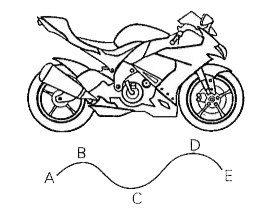
Somesh is driving motorcycle, in a zigzag way on the road. His motorbike moves on a road and traces a curved path. The path traced by it is shown by the curve ABCDE.

The pattern of the path traced is in the shape of parabola. In mathematical form, the given path followed the polynomial expression in the form
`p(x)=a_(n)x^(n)+a_(n-1)x^(n-1)+a_(n-2)x^(n-2)+`.....
What is the polynomial representation of the path traced by the bike, when zeroes are 2 and -4,

A

`x^(2)+2x-8`

B

`x^(2)-2x-8`

C

`x^(2)-4x-8`

D

`x^(2)+2x+8`

Text Solution

Verified by Experts

The correct Answer is:

A
Promotional Banner

Topper's Solved these Questions

  • SAMPLE PAPER 02

    EDUCART PUBLICATION|Exercise SECTION - A|11 Videos
  • SAMPLE PAPER 02

    EDUCART PUBLICATION|Exercise SECTION - A Fill in the blanks|6 Videos
  • SAMPLE PAPER 02

    EDUCART PUBLICATION|Exercise SECTION-B|20 Videos
  • SAMPLE PAPER 01

    EDUCART PUBLICATION|Exercise PART-B (SECTION-V)|4 Videos
  • SAMPLE PAPER 03

    EDUCART PUBLICATION|Exercise Section - C|10 Videos

Similar Questions

Explore conceptually related problems

Somesh is driving motorcycle, in a zigzag way on the road. His motorbike moves on a road and traces a curved path. The path traced by it is shown by the curve ABCDE. The pattern of the path traced is in the shape of parabola. In mathematical form, the given path followed the polynomial expression in the form p(x)=a_(n)x^(n)+a_(n-1)x^(n-1)+a_(n-2)x^(n-2)+ ..... Which of the following describes the shape of the curve CDE?

Somesh is driving motorcycle, in a zigzag way on the road. His motorbike moves on a road and traces a curved path. The path traced by it is shown by the curve ABCDE. The pattern of the path traced is in the shape of parabola. In mathematical form, the given path followed the polynomial expression in the form p(x)=a_(n)x^(n)+a_(n-1)x^(n-1)+a_(n-2)x^(n-2)+ ..... If the shape of the curve ABC is represented by quadratic equation x^(2) - 7x + 12 then its zeroes are:

Differentiate |x|+a_(0)x^(n)+a_(1)x^(n-1)+a_(2)x^(n-1)+...+a_(n-1)x+a_(n)

Let f(x) =a_(0)x^(n)+a_(1)x^(n-1)+...+a_(n)(a_(0)ne0) be a polynomial of degree n . If x+1 is one of its factors, then______.

Differentiate the following with respect of x:a_(0)x^(n)+a_(1)x^(n-1)+a_(2)x^(n-2)++a_(n-1)x+a_(n)

(1+x)^(n)=a_(0)+a_(1)x+a_(2)*x^(2)+......+a_(n)x^(n) then prove that

Draw the Graph of Polynomial when polynomial function is in standard form f(x)=a_(n)x^(n)+a_(n-1)x^(n-1)+......a_(1)x+a_(0)-( i)Leading coefficient is positive (ii)Leading cofficient is negative

In the given figure graph of : y =p (x) = x ^(n)+a_(1) x ^(n-1) +a_(2) x ^(n-2)+ ….. + a _(n) is given. The product of all imaginary roots of p(x) =0 is:

Write the following sets in roster form: (i)A={a_(n):n varepsilon N,a_(n)+1=3a_(n),a_(1)=2

a_(0)f^(n)(x)+a_(1)f^(n-1)(x)*g(x)+a_(2)f^(n-2)g^(2)(x)+......+a_(n)g^(n)(x)>=0
