

Home
Class 7
MATHS
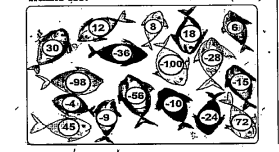
The fish in the pond below carry some nm...

The fish in the pond below carry some nmbers.choose any 4 pairs and carry out four multiplications with those numers.Now choose four other pairs and carry out divisions with those numbers.

for example `(-10) xx 6 = -60`

Promotional Banner

Topper's Solved these Questions

  • FRACTIONS AND DECIMALS

    SRS PUBLICATION|Exercise QUESTION BANK|246 Videos
  • LINES AND ANGLES

    SRS PUBLICATION|Exercise QUESTION BANK|194 Videos

Similar Questions

Explore conceptually related problems

It is tempting to think that all possible transitions are permissible, and that an atomic spectrum arises from the transition of the electron from any initial orbital to any other orbital. However, this is not so, because a photon has an intrinsic spin angular momentum of sqrt2 (h)/(2pi) corresponding to S = 1 although it has no charge and no rest mass. On the other hand, an electron has got two types of angular momentum : Orbital angular momentum, L=sqrt(l(l+1))h/(2pi) and spin angular momentum, arising from orbital motion and spin motion of electron respectively. The change in angular momentum of the electron during any electronic transition must compensate for the angular momentum carries away by the photon. to satisfy this condition the difference between the azimuthal quantum numbers of the orbital within which transition takes place must differ by one. Thus, an electron in a d-orbital (1 = 2) cannot make a transition into an s = orbital (I = 0) because the photon cannot carry away enough angular momentum. An electron as is well known, possess four quantum numbers n, I, m and s. Out of these four I determines the magnitude of orbital angular momentum (mentioned above) while (2n m determines its z-components as m((h)/(2pi)) the permissible values of only integers right from -1 to + l. While those for I are also integers starting from 0 to (n − 1). The values of I denotes the sub shell. For I = 0, 1, 2, 3, 4,..... the sub-shells are denoted by the symbols s, p, d, f, g, .... respectively The orbital angular momentum of an electron in p-orbital makes an angle of 45^@ from Z-axis. Hence Z-component of orbital angular momentum of election is :

It is tempting to think that all possible transitions are permissible, and that an atomic spectrum arises from the transition of the electron from any initial orbital to any other orbital. However, this is not so, because a photon has an intrinsic spin angular momentum of sqrt2 (h)/(2pi) corresponding to S = 1 although it has no charge and no rest mass. On the other hand, an electron has got two types of angular momentum : Orbital angular momentum, L=sqrt(l(l+1))h/(2pi) and spin angular momentum, arising from orbital motion and spin motion of electron respectively. The change in angular momentum of the electron during any electronic transition must compensate for the angular momentum carries away by the photon. to satisfy this condition the difference between the azimuthal quantum numbers of the orbital within which transition takes place must differ by one. Thus, an electron in a d-orbital (1 = 2) cannot make a transition into an s = orbital (I = 0) because the photon cannot carry away enough angular momentum. An electron as is well known, possess four quantum numbers n, I, m and s. Out of these four I determines the magnitude of orbital angular momentum (mentioned above) while (2n m determines its z-components as m((h)/(2pi)) he permissible values of only integers right from -1 to + l. While those for I are also integers starting from 0 to (n − 1). The values of I denotes the sub shell. For I = 0, 1, 2, 3, 4,..... the sub-shells are denoted by the symbols s, p, d, f, g, .... respectively The maximum orbital angular momentum of an electron with n= 5 is

It is tempting to think that all possible transitions are permissible, and that an atomic spectrum arises from the transition of the electron from any initial orbital to any other orbital. However, this is not so, because a photon has an intrinsic spin angular momentum of sqrt2 (h)/(2pi) corresponding to S = 1 although it has no charge and no rest mass. On the other hand, an electron has got two types of angular momentum : Orbital angular momentum, L=sqrt(l(l+1))h/(2pi) and spin angular momentum, arising from orbital motion and spin motion of electron respectively. The change in angular momentum of the electron during any electronic transition mush compensate for the angular momentum carries away by the photon. to satisfy this condition the difference between the azimuthal quantum numbers of the orbital within which transition takes place must differ by one. Thus, an electron in a d-orbital (1 = 2) cannot make a transition into an s = orbital (I = 0) because the photon cannot carry away enough angular momentum. An electron as is well known, possess four quantum numbers n, I, m and s. Out of these four I determines the magnitude of orbital angular momentum (mentioned above) while (2n m determines its z-components as m((h)/(2pi)) the permissible values of only integers right from -1 to + l. While those for I are also integers starting from 0 to (n − 1). The values of I denotes the sub shell. For I = 0, 1, 2, 3, 4,..... the sub-shells are denoted by the symbols s, p, d, f, g, .... respectively The spin-only magnetic moment of free ion is sqrt(8) B.M. The spin angular momentum of electron will be

Two strips of metal are riveted together at their ends by four rivets, each of diameter 6.0 mm. What is the maximum tension that can be exerted by the riveted strip if the shearing stress on the rivet is not to exceed 6.9xx10^(7) Pa ? Assume that each rivet is to carry one quarter of the load.

A reaction S_((g)) hArr 4S_(2(g)) is s carried out by taking 2 moles of S_(8(g)) and 0.2 mole of S_(2(g)) in a reaction vessel of l lit. Which one is not correct. If K_(c) = 6.3 xx 10^(-6) .

The number density of free electrons in a copper conductor estimated in textual example 6.1 is 8.5 xx 10^(28) m^(-3) . How long does an electrons take to drift from one end of a wire 3.0 m long to its other end? The area of cross-section of the wire is 2.0 xx 10^(-6) m^(2) and it is carrying a current of 3.0 A