Home
Class 10
BIOLOGY
Explain the three pathways of breakdown ...

Explain the three pathways of breakdown in living organisms.

Text Solution

Verified by Experts
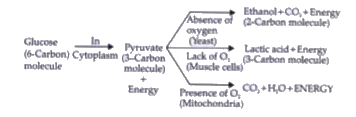
The food material taken inside the body is further processed in cells to generate energy for various life processes. Different organisms perform various pathways for the breakdown of glucose into water and energy completely. Depending upon the condition of oxygen present or absent during the reaction, the end products vary from organism to organism. However, in all the cases, the first step lies in common with the breakdown of 6 carbon molecule glucose to that of the 3 carbon molecule known as pyruvate. Also, the energy released in aerobic condition is much more than that of the energy produced under anaerobic conditions. `"Glucose" to "Pyruvate" + "Energy"`
Further, if this process takes place in cytoplasm i.e. anaerobic conditions, pyruvate is then converted to ethanol and carbon dioxide. Similarly, if the reaction occurs inside mitochondria i.e. aerobic conditions converts the pyruvate into carbon dioxide, water and energy.
(i) Aerobic conditions are prevalent in the presence of oxygen. In mitochondria, majorly such reactions are found where oxygen is available in abundance to convert the pyruvate into water, energy and `CO_2`

(ii) Anaerobic conditions can occur in two cases :
(a) Oxygen deficient condition present in cytoplasm produces ethyl alcohol, energy and carbon dioxide. Such products are also released by yeast during the process of fermentation.
(b) Lack of oxygen is observed in some cases due to excessive exercise when the oxygen content in muscle cells is used up completely. In such cases, lactic acid is produced along with the energy as a by-product.
Promotional Banner

Topper's Solved these Questions

  • LIFE PROCESSES

    OSWAL PUBLICATION|Exercise BOARD CORNER (SHORT ANSWER TYPE QUESTIONS)|8 Videos
  • LIFE PROCESSES

    OSWAL PUBLICATION|Exercise BOARD CORNER (LONG ANSWER TYPE QUESTIONS)|2 Videos
  • LIFE PROCESSES

    OSWAL PUBLICATION|Exercise NCERT EXEMPLAR (SHORT ANSWER QUESTIONS) (NAME THE FOLLOWING :)|42 Videos
  • HOW DO ORGANISMS REPRODUCE ?

    OSWAL PUBLICATION|Exercise CREATING BASED QUESTIONS|6 Videos
  • MANAGEMENT OF NATURAL RESOURCES

    OSWAL PUBLICATION|Exercise CASE-BASED MCQs|15 Videos

Similar Questions

Explore conceptually related problems

Growth in living organisms occurs by

Smallest living organism is

Which pathway of respiration is common in all living organisms ? Where does it occur inside the cell and what are its products ?

Name the 10-step pathway which occurs in all living organisms (aerobes and anaerobes) without without the help of oxygen. In which part of the cell does it occur ?

To determine the type of organic compounds found in living organisms, the living tissue is ground in

Smallest free living organism is

The pathway of respiration common in all living organisms is ul(x) , it occurs in the ul(y) and the products formed are two molecules of ul(Z) . Identify X,Y and Z in the above paragraph and select the correct answer.

To determine the type of organic compounds found in living organism, the living tissue is ground with the help of a mortar and a pestle in

