Home
Class 10
BIOLOGY
According to the ‘Solid Waste Management...


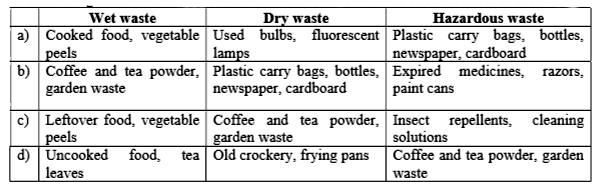
According to the ‘Solid Waste Management Rule 2016’, the waste should be segregated into three categories. Observe the table below and select the row that has correct information

Text Solution

Verified by Experts

The correct Answer is:

B
Promotional Banner

Topper's Solved these Questions

  • NEW CHAPTERS AND QUESTIONS BASED ON LATEST TYPOLOGIES INTRODUCED BY CBSE FOR 2021-22 EXAMINATION

    OSWAL PUBLICATION|Exercise CONTROL AND COORDINATION (SELF ASSESSMENT -1 ) (OBJECTIVE TYPE QUESTIONS) (A. Multiple Choice Questions)|3 Videos
  • NEW CHAPTERS AND QUESTIONS BASED ON LATEST TYPOLOGIES INTRODUCED BY CBSE FOR 2021-22 EXAMINATION

    OSWAL PUBLICATION|Exercise CONTROL AND COORDINATION (SELF ASSESSMENT -1 ) (OBJECTIVE TYPE QUESTIONS) (B. Assertion and Reason Type Questions)|2 Videos
  • NEW CHAPTERS AND QUESTIONS BASED ON LATEST TYPOLOGIES INTRODUCED BY CBSE FOR 2021-22 EXAMINATION

    OSWAL PUBLICATION|Exercise MANAGEMENT OF NATURAL RESOURCES (BOARD CORNER) (Short Answer Type Questions)|19 Videos
  • MANAGEMENT OF NATURAL RESOURCES

    OSWAL PUBLICATION|Exercise CASE-BASED MCQs|15 Videos
  • NTSE 2019 - 20

    OSWAL PUBLICATION|Exercise (BIOLOGY) WHY DO WE FALL ILL (STAGE - 1)|2 Videos

Similar Questions

Explore conceptually related problems

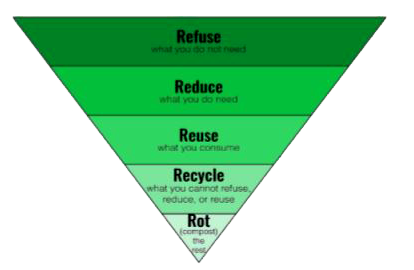
Observe the following diagram According to the 'Solid Waste Management Rule 2016' , the waste should be segregrated into three categories. Observe the table below and select the row that has correct information

Study the table below and select the row that has the correct information:

Identify the substances marked X and Y from the figure below and select the row containing correct information:

All living cells require energy for various activities. This energy is available by the breakdown of simple carbohydrates either using oxygen or without using oxygen. Study the table below and select the row that has the incorrect information.

Case 2 : the biological process involved in the removal of harmful metabolic wastes from the bosy is called excertion .Different organisms use varied strategies to do this Many unicellular organisms remove these wastes by simple diffusion from the body surface into the surrounding water while complex multicellular organisms use specialised organs to perform the same function . Study the table below and select the incorrect match .

Potassium iodide solution is added to lead nitrate solution in a test tube. Select the correct observation from the table below:

Given below is the process to separate the contents of a living tissue by acid treatment and a list of certain observations . Segregate the observations under filtrate (A) and retentate (B) and select the correct combination . 1. Molecular weight ranging from 18 - 800 daltons approx. 2. Proteins, nucleic acids , polysaccharides and lipids 3. Chemicals more than 800 daltons molecular weight 4. Has monomers 5. Generally has polymers

The e-waste (Management and Handling) Rules. 2011, notified by the Ministry of Environment and Forests, have the potential to turn a growing problem into a developmental opportunity. With almost half-a-year to go before the rules take effect, there is enough time to create the necessary infrastructure for collection. dismantling and recycling of electronie waste. The focus must be on sincere and efficient implementation. Only decisive action can reduce the pollution and health costs associated with India's hazardous waste recycling industry. If India can achieve a transformation, it will be creating a whole new employment sector that provides good wages and working conditions for tens of thousands. The legacy response of the States to even the basic law on urban waste, the Municipal Solid Wastes (Management and Handling) Rules has been one of indifference, many cities continue to simply burn the garbage or dump it in lakes. With the emphasis now on segregation of waste at source and recovery of materials. it should be feasible to implement both sets of rules efficiently. A welcome feature of the new ewaste rules is the emphasis on extended producer responsibility. In other words, producers must,take responsbility for the disposal of end of-life products For this provision to work, they must ensure that consumers who sell scrap get some form of financial incentive, The e-waste rules, which derive from those pertaining to hazardous waste, are scheduled to come into force on May· 1, 2012. Sound as they are, the task of scientifically disposing a few hundred thousand tonnes of trash electronics annually depends heavily on a system of oversight by State Pollutions Control Boards:(PCBs). Unfortunately, most PCBs remain unaccountable and often lack the resources for active enforcement. It must be pointed out that although agencies handling e-waste must obtain environmental clearances and be authorised and registered by the PCBs even under the Hazardous Wastes (Management, Handling and Transboundary Movement) Rules 2008, there has been little prnctical impact. Over 95 per cent of electronic waste is collected and recycled by the informal sector. The way forward is for the PCBs to be made accountable for enforcement of thee- waste rules and the levy of penalties under environmental laws. Clearly, the first order priority is to create a system that will absorb the sn,oo0-strong workforce in the informal sector into the proposed scheme for scientific recycling. Facilities must be . · created to upgrade' the skills of these workers through training and' their occupational health must be ensured. Recycling ofo-wasteis one of the biggest challenges today. In such 'a time, when globalisation and information technology are growing at a pace which could only be imagined few years back, e-waste and its hazards have become more prominent over a period of time arid should be given immediate attention. What, according to the passage, is important now for ewaste management?

The e-waste (Management and Handling) Rules. 2011, notified by the Ministry of Environment and Forests, have the potential to turn a growing problem into a developmental opportunity. With almost half-a-year to go before the rules take effect, there is enough time to create the necessary infrastructure for collection. dismantling and recycling of electronie waste. The focus must be on sincere and efficient implementation. Only decisive action can reduce the pollution and health costs associated with India's hazardous waste recycling industry. If India can achieve a transformation, it will be creating a whole new employment sector that provides good wages and working conditions for tens of thousands. The legacy response of the States to even the basic law on urban waste, the Municipal Solid Wastes (Management and Handling) Rules has been one of indifference, many cities continue to simply burn the garbage or dump it in lakes. With the emphasis now on segregation of waste at source and recovery of materials. it should be feasible to implement both sets of rules efficiently. A welcome feature of the new ewaste rules is the emphasis on extended producer responsibility. In other words, producers must,take responsbility for the disposal of end of-life products For this provision to work, they must ensure that consumers who sell scrap get some form of financial incentive, The e-waste rules, which derive from those pertaining to hazardous waste, are scheduled to come into force on May· 1, 2012. Sound as they are, the task of scientifically disposing a few hundred thousand tonnes of trash electronics annually depends heavily on a system of oversight by State Pollutions Control Boards:(PCBs). Unfortunately, most PCBs remain unaccountable and often lack the resources for active enforcement. It must be pointed out that although agencies handling e-waste must obtain environmental clearances and be authorised and registered by the PCBs even under the Hazardous Wastes (Management, Handling and Transboundary Movement) Rules 2008, there has been little prnctical impact. Over 95 per cent of electronic waste is collected and recycled by the informal sector. The way forward is for the PCBs to be made accountable for enforcement of thee- waste rules and the levy of penalties under environmental laws. Clearly, the first order priority is to create a system that will absorb the sn,oo0-strong workforce in the informal sector into the proposed scheme for scientific recycling. Facilities must be . · created to upgrade' the skills of these workers through training and' their occupational health must be ensured. Recycling ofo-wasteis one of the biggest challenges today. In such 'a time, when globalisation and information technology are growing at a pace which could only be imagined few years back, e-waste and its hazards have become more prominent over a period of time arid should be given immediate attention. "Both sets of rules" is being referred to which of the following?

The e-waste (Management and Handling) Rules. 2011, notified by the Ministry of Environment and Forests, have the potential to turn a growing problem into a developmental opportunity. With almost half-a-year to go before the rules take effect, there is enough time to create the necessary infrastructure for collection. dismantling and recycling of electronie waste. The focus must be on sincere and efficient implementation. Only decisive action can reduce the pollution and health costs associated with India's hazardous waste recycling industry. If India can achieve a transformation, it will be creating a whole new employment sector that provides good wages and working conditions for tens of thousands. The legacy response of the States to even the basic law on urban waste, the Municipal Solid Wastes (Management and Handling) Rules has been one of indifference, many cities continue to simply burn the garbage or dump it in lakes. With the emphasis now on segregation of waste at source and recovery of materials. it should be feasible to implement both sets of rules efficiently. A welcome feature of the new ewaste rules is the emphasis on extended producer responsibility. In other words, producers must,take responsbility for the disposal of end of-life products For this provision to work, they must ensure that consumers who sell scrap get some form of financial incentive, The e-waste rules, which derive from those pertaining to hazardous waste, are scheduled to come into force on May· 1, 2012. Sound as they are, the task of scientifically disposing a few hundred thousand tonnes of trash electronics annually depends heavily on a system of oversight by State Pollutions Control Boards:(PCBs). Unfortunately, most PCBs remain unaccountable and often lack the resources for active enforcement. It must be pointed out that although agencies handling e-waste must obtain environmental clearances and be authorised and registered by the PCBs even under the Hazardous Wastes (Management, Handling and Transboundary Movement) Rules 2008, there has been little prnctical impact. Over 95 per cent of electronic waste is collected and recycled by the informal sector. The way forward is for the PCBs to be made accountable for enforcement of thee- waste rules and the levy of penalties under environmental laws. Clearly, the first order priority is to create a system that will absorb the sn,oo0-strong workforce in the informal sector into the proposed scheme for scientific recycling. Facilities must be . · created to upgrade' the skills of these workers through training and' their occupational health must be ensured. Recycling ofo-wasteis one of the biggest challenges today. In such 'a time, when globalisation and information technology are growing at a pace which could only be imagined few years back, e-waste and its hazards have become more prominent over a period of time arid should be given immediate attention. e-waste rules have been derived from those pertaining to'

OSWAL PUBLICATION-NEW CHAPTERS AND QUESTIONS BASED ON LATEST TYPOLOGIES INTRODUCED BY CBSE FOR 2021-22 EXAMINATION -MANAGEMENT OF NATURAL RESOURCES (VISUAL CASE-BASED)
  1. Choose the waste management strategy that is matched with correct exam...

    Text Solution

    |

  2. Recycling of paper is a good practice but recycled paper should not be...

    Text Solution

    |

  3. According to the ‘Solid Waste Management Rule 2016’, the waste should ...

    Text Solution

    |

  4. Effective segregation of wastes at the point of generation is very imp...

    Text Solution

    |

  5. When recycling a plastic water bottle, what should you do with the cap...

    Text Solution

    |

  6. The Ganga runs its course of over 2500 km from Gangotri in the Himalay...

    Text Solution

    |

  7. The Ganga runs its course of over 2500 km from Gangotri in the Himalay...

    Text Solution

    |

  8. The Ganga runs its course of over 2500 km from Gangotri in the Himalay...

    Text Solution

    |

  9. The Ganga runs its course of over 2500 km from Gangotri in the Himalay...

    Text Solution

    |

  10. The Ganga runs its course of over 2500 km from Gangotri in the Himalay...

    Text Solution

    |

  11. Visualize the following figures and answer the question . Which f...

    Text Solution

    |

  12. Visualize the following figures and answer the question . Which f...

    Text Solution

    |

  13. Visualize the following figures and answer the question . Which h...

    Text Solution

    |

  14. Visualize the following figures and answer the question . A villa...

    Text Solution

    |

  15. Visualize the following figures and answer the question . Which ...

    Text Solution

    |

  16. Management and conservation of natural resources means the scientific ...

    Text Solution

    |

  17. Management and conservation of natural resources means the scientific ...

    Text Solution

    |

  18. Management and conservation of natural resources means the scientific ...

    Text Solution

    |

  19. Management and conservation of natural resources means the scientific ...

    Text Solution

    |

  20. Management and conservation of natural resources means the scientific ...

    Text Solution

    |
