Home
Class 10
PHYSICS
Carbon cannot reduce the oxides of sodiu...

Carbon cannot reduce the oxides of sodium, magnesium and aluminium to their respective metals. Why? Where are these metals placed in the reactivity series? How are these metals obtained from their ores? Take an example to explain the process of extraction along with chemical equations.

Text Solution

Verified by Experts
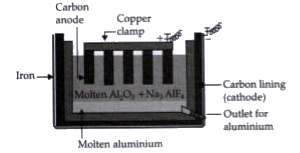
Metals which are placed high in the reactivity series such as sodium, calcium, magnesium, aluminium etc. are very reactive. These metals have high affinity for oxygen than carbon. Therefore, these metals cannot be obtained by reduction with carbon
For such metals, electrolytic reduction process is used for obtaining metal .
Electrolytic reduction of aluminium : Molten aluminium oxide is electrolysed to produce pure aluminium at the cathode while oxygen gas is produced at the anode
`A l^(3+) + 3e^(-)` to Al` (aluminum metal at the (-) cathode )
`2O^(2-) - 4e^(-) to O_(2)` (oxygen gas at the (+) anode )

Electrolytic cell for the extraction of aluminium
Promotional Banner

Similar Questions

Explore conceptually related problems

Why should the metal sulphides and carbonates be converted to metal oxides in the process of extraction of metal from them?

Name the principle ore of aluminium. How is the metal extracted from this ore ?

Explain by giving one example, how highly reactive metals (which are high up in the reactivity series) are extracted.

how are the less reactve metals (which are quite low in the reactivity series) extracted? Explain with the help of an example.

Describe with one example, how moderately reactive metals (which are in the middle of reactivity series) are extracted.

How is the method of extraction of metals high up in the reactivity series different from that for metals in the middle? Why can the same process not be applied for them? Name the process used for extraction of these metals.

