

Home
Class 8
MATHS
We know that parallelogram is also a qua...

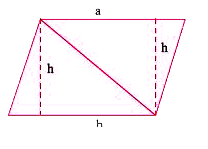
We know that parallelogram is also a quadrilateral. Let us split such a quadrilateral into two triangles. Find their areas and subsequently that of the parallelogram. Does this process in tune with the formula that you already know?

Promotional Banner

Similar Questions

Explore conceptually related problems

We know that parallelogram is also a quadrilateral. Let us split such quadrilateral into two triangles. Find their areas and subsequently that of the parallelogram. Does this process in turn with the formula that you already know?

What would happen if the quadrilateral is not convex? Consider quadrilateral ABCD. Split it into two triangles and find the sum of the interior angles. What is the sum of interior angles of a concave quadrilateral?

Draw circles having different radius on à graph paper. Find the area by counting the number of squares, Also find the area by using formula. Compare the two answers.

Do you know we also use some particulate pollutants? Could you list some of them?

Represent the following situations with suitable mathematical equations. The hypotenuse of a right triangle is 25 cm. We know that the difference in lengths of the other two sides is 5 cm. We would like to find out the length of the two sides?

Represent the following situations mathematically The hypotenuse of a right triangle is 25cm. We know that the difference in lengths of the other two sides is 5 cm. We would like to find out the length of the two sides.

The two adjacent sides of a parallelogram are 2hati-4hatj+5kandhati-2hatj-3hatk . Find the unit vector parallel to its diagonal Also , find its area.

Now in the same way, let us study a plant or a tree as habitat. Birds, monkeys, squirrels, snakes, ants, spiders, caterpillars, moths, bees, wasps, small plants (mosses), mosquitoes are some organisms that you may find on a-tree. Try to classify them in table 5 based on where you find them. Add some more examples that you know.