Home
Class 12
CHEMISTRY
A metal gives two chlorides 'A' and 'B'....

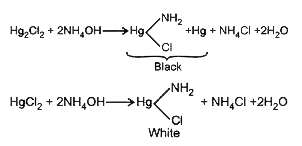
A metal gives two chlorides 'A' and 'B'.' A' gives a black precipitate with NH4 OH and 'B' gives white. 'B' gives a red precipitate on reaction with KI which is soluble in excess of KI. Identify 'A' and 'B', respectively.

A

`Hg Cl _(2) and Hg _(2) Cl_(2)`

B

`Hg _(2) Cl _(2) and Hg Cl _(2)`

C

`Hg Cl _(2) and Hg OCl`

D

None of these

Text Solution

Verified by Experts

The correct Answer is:
B

A. is `Hg _(2) Cl and .B. Is Hg Cl _(2)`

`Hg Cl _(2) + 2 Kl to underset( Red) ( Hg l _(2)) + 2 KCl `
`H g l _(2) + 2 Kl to underset( "Soluble")( K _(2) H g l _(4))`
Promotional Banner

Topper's Solved these Questions

  • NTA TPC JEE MAIN TEST 72

    NTA MOCK TESTS|Exercise CHEMISTRY |30 Videos
  • NTA TPC JEE MAIN TEST 80

    NTA MOCK TESTS|Exercise CHEMISTRY |29 Videos

Similar Questions

Explore conceptually related problems

A metal gives two chlorides 'A' and 'B'.'A' gives black precipitate with NH_(4)OH and 'B' gives white ppt. With KI 'B' gives a red precipitate soluble in excess of KI.'A' and 'B' are respectively :

Which will not give precipitate with NH_(4)OH Solution ?

A metal nitrate on reaction with KI gives black precipitate and with excess KI gives orange solution. The metal ion is ,

A nitrate when mixed with common salt gives a white precipitate which is soluble in dilute NH_(4)OH . It is the nitrate of

Give examples and explain with equations: (a)Two colourless solution give a black precipitate on mixing. (b)Two colourless solutions give a red precipitate on mixing, soluble in excess of one of them. ( c)Two colourless solutions give a white precipitate on mixing, soluble in ammonium hydroxide. (d)Two colourless solutions give a yellow precipitate on mixing.

Sodiumfusion Extract is acidified with HNO_(3) and then treated with AgNO_(3) solution if the organic compound contains halogens. In which of halogen gives white precipitate & which is soluble in NH_(4)OH solution. Second halogen gives yellow ppt and which is insoluble in NH_(4)OH solution. Identify the halogens respectively.

Which one of the following gives a red precipitate with ammoniacal solution of cuprous chloride?

NTA MOCK TESTS-NTA TPC JEE MAIN TEST 79-CHEMISTRY
  1. Among CHCl(3), CH(4) and SF(4) the molecules do not having regular ge...

    Text Solution

    |

  2. Which of the following is obtained by Teaching process and can be used...

    Text Solution

    |

  3. A metal gives two chlorides 'A' and 'B'.' A' gives a black precipitate...

    Text Solution

    |

  4. Among [Ni ( CO ) (4) ] , [Ni (CN) (4) ]^(2-) and [Ni (Cl) (4) ]^(2-):-

    Text Solution

    |

  5. Select wrong statement:

    Text Solution

    |

  6. Which of the following is not the product of dehydration of

    Text Solution

    |

  7. Phenol and benzoic acid can be distinguished by :

    Text Solution

    |

  8. Which compound undergoes electrophilic substitution with ease (most r...

    Text Solution

    |

  9. Which of the following statements are correct? (i) Sucrose is dext...

    Text Solution

    |

  10. Which of the following will not give iodo form test:

    Text Solution

    |

  11. Which of the following compounds are meso forms?

    Text Solution

    |

  12. Which of the following statements is valid for the above compound?

    Text Solution

    |

  13. Reaction by which benzaldehyde can not be prepare :

    Text Solution

    |

  14. A solution contains Pb^(+ 2)ion. In order to precipitate Pb^(+2 ) ions...

    Text Solution

    |

  15. Antifluorite structure can be obtained from fluorite structure by:

    Text Solution

    |

  16. The e/m ratio is maximum for :

    Text Solution

    |

  17. In a reaction between A and B, the initial rate of reaction was measur...

    Text Solution

    |

  18. If we place 0.5 g Lithium metal in coffee cup calorimeter that already...

    Text Solution

    |

  19. Colourless radical among the following: [TiF (6) ] ^(2-), [Co F (6...

    Text Solution

    |

  20. IF(7) is an interhalogen compound. The total count of lone pairs in o...

    Text Solution

    |

