Home
Class 12
PHYSICS
In a hall, a person receives direct soun...

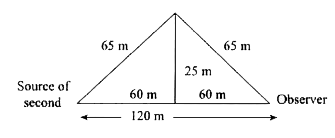
In a hall, a person receives direct sound waves from a source `120 m` away. He also receives waves from the same source which reach him after being reflected from the `25 m` high ceiling at a point halfway between them. The two waves interfere constructively for wavelengths (in metres)

A

`5,2,5, (5)/(3) ....m`

B

`10,5, (1)/(3).....m`

C

`2, (20)/(3) , 4 ....m`

D

`10, (10)/(3), 2 .....m`

Text Solution

Verified by Experts

The correct Answer is:
B

Let , the length of path of the sound directly from the source be `x_(1)`
the length of path of the sound after getting reflected from the ceilling be `x _(2)`
`x _(1) = 120 m`


`x _(2) = 65 + 65 = 130 m`
Path difference between the waves is
`Delta x = 130 - 120 = 10 m`
Also, for constructive interference path difference, `Delta x = n lamda `
`lamda = ( Delta x )/(n) = (10)/( n)`
The wavelengths of the wave for maximum are
`lamda = 10,5, (10)/(3), (10)/(4) , (10)/(5)...`
`[because n =1,2,3,...]`
Promotional Banner

Topper's Solved these Questions

  • NTA TPC JEE MAIN TEST 72

    NTA MOCK TESTS|Exercise PHYSICS |30 Videos
  • NTA TPC JEE MAIN TEST 80

    NTA MOCK TESTS|Exercise PHYSICS |30 Videos

Similar Questions

Explore conceptually related problems

In a large room, a person receives direct sound waves froma source 120 metres away from him. He also receives waves from the same source which reach him, being reflected from the 25 metre high ceiling at a point halfway between them. The two waves interfere constuctively for wavelength of

In a large room , a person receives waves from the same source which reach , being reflected from the 25 m high ceiling at a point halfway between them . The two waves interfere constructively for a wavelength of

In a large room , a person receives direct sound waves from a source 120 m away . He also receives waves from the same source which reach him after being reflected from the 5 - m high ceiling at a point halfway between them . For which wavelengths will these two sound waves interfere constructively ?

A detector at x=0 receives waves from three sources each of amplitude A and frequencies f + 2,f and f-2 . The time at which intensity is maximum, is

A thin glass slab G1 is held over a large glass slab G2, creating an air gap of uniform thickness t = 0.5 mum between them. Electromagnetic wave having wavelengths ranging from 0.4 mum "to" 1.15 mum is incident normally on the slab G1. When interference between waves reflected from boundaries of air gap (the two reflected waves are shown in fig as R1 and R2) was studied, it was found that only two wavelengths interfered constructively. One of these two wavelengths is lambda_(1) = 0.04 mum . Find the other wavelength (lambda_(2)) that interferes constructively.

A person standing at a distance of 6 m from a source of sound receives sound wave in two ways, one directly from the source and other after reflection from a rigid boundary as shown in figure. The maximum wavelength for which, the person will receive maximum sound intensity, is

The path length difference between two waves coming from coherent sources for destructive interference should be

A source S and a detector D are placed at a distance d apart. A big cardboard is placed at a distance sqrt(2) d from the source and the detector as shown in figure. The source emits a wave of wavelength = d//2 which is received by the detector after reflection from the cardboard. It is found to be in phase with the direct wave received from the source. By what minimum distance should the cardboard be shifted away so that the reflected wave becomes out of phase with the direct wave?

NTA MOCK TESTS-NTA TPC JEE MAIN TEST 79-PHYSICS
  1. For a gas sample with N(0) number of molecules, function N (V) is giv...

    Text Solution

    |

  2. jn A magnet of length 'L' and magnetic moment M is given. What will be...

    Text Solution

    |

  3. In a hall, a person receives direct sound waves from a source 120 m aw...

    Text Solution

    |

  4. Read the following statements carefully : (i) product of a volt and an...

    Text Solution

    |

  5. Water is flowing in a streamline down the incline having inclination 3...

    Text Solution

    |

  6. A bead of mass m is located on a parabolic wire with its axis vertical...

    Text Solution

    |

  7. The amount of heat required to raise the temperature of 10 g liquid fr...

    Text Solution

    |

  8. Two moles of helium gas undergo a cyclic process as shown in figure. A...

    Text Solution

    |

  9. In a double slit experiment, interference is obtained from electron wa...

    Text Solution

    |

  10. A particle of mass m slides on a frictionaless surface ABCD, starting ...

    Text Solution

    |

  11. The energy flux of sunlight reaching the surface of the earth is 1.388...

    Text Solution

    |

  12. Calculate the current drawn by the primary of a tarnsformer which step...

    Text Solution

    |

  13. If I(1),I(2) and I(3) are the moments of inertia about the natural axi...

    Text Solution

    |

  14. What should be the wavelength (in Å ) of X-ray used for getting the f...

    Text Solution

    |

  15. Let the time period of a satellite is 20 hours which is revolving in e...

    Text Solution

    |

  16. A ray of light enters a spherical drop of refractive index (mu = ( 5)/...

    Text Solution

    |

  17. What is the electric force(in N) experienced by a charge of 1 coulomb ...

    Text Solution

    |

  18. The scalar product of two vectors is 2 sqrt(3) and the magnitude of th...

    Text Solution

    |

  19. Four blocks are connected with a.string passing over a frictionless pu...

    Text Solution

    |

  20. A rectangular coil (Dimension 6cm xx 4.5 cm ) with 200 turns, carrying...

    Text Solution

    |

