Home
Class 12
MATHS
A manufacturer has three machines I, II ...

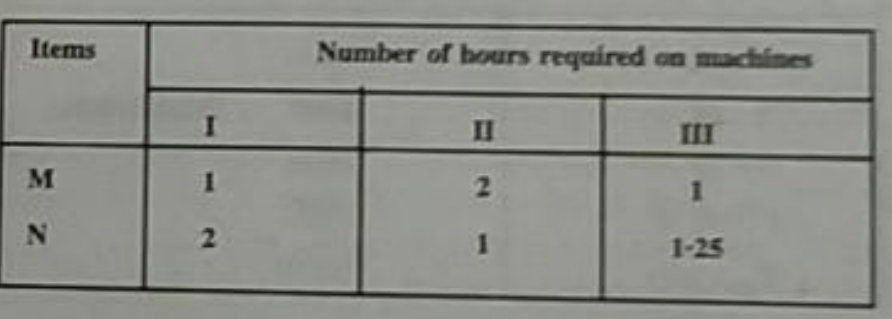
A manufacturer has three machines I, II and III installed in his factory. Machines I and II are capable of being operated for at most 12 hours whereas machine III must be operated for at least 5 hours a day. She produces only two items M and N each on the three machines are given in the following table:
SHe makes a profit of Rs 600 and Rs 400 on items M and N respectively. How many of each item should she produce so as to maximise her profit assuming that she can sell all the items that she produced? What will be the maximum Profit?


Promotional Banner

Topper's Solved these Questions

  • LINEAR PROGRAMMING

    MODERN PUBLICATION|Exercise EXERCISE|156 Videos
  • INVERSE-TRIGONOMETRIC FUNCTIONS

    MODERN PUBLICATION|Exercise EXERCISE|111 Videos
  • MATRICES

    MODERN PUBLICATION|Exercise EXERCISE|232 Videos

Similar Questions

Explore conceptually related problems

Why machines are sometimes jammed in winter?

A manufacturer produces nuts and bolts. It takes 1 hour of work on machine A and 3 hours on machine B to produce a package of nuts. It takes 3 hours on machine A and 1 hour on machine B to produce a package of bolts. He earns a profit of Rs17.50 per package on nuts and Rs 7.00 per package on bolts. How many packages of each should be produced each day so as to maximise his profit, if he operates his machines for at the most 12 hours a day?

A factory owner purchases two types of machines, A and B fo his factory. The requirements and the limitation for the machines are as followes : He has maximum area of 9000 m^2 available, and 72 skilled labourers who can operate both the machines. How many machines of each type should be buy to maximise the daily output ?

A factory owner purchases two types of machines A and B for his factory. The requirements and limtations for the machines are as follows: He has an area of 9000 sq m available and 72 skilled men who can operate the machines. How many machines of each type should he buy to maximize th daily output?

A furniture dealer deals in only two items tables chairs. He has Rs 5000 to invest and a space to store at most 60 pieces. A table costs him Rs 250 and a chair Rs 50. He can sell a table at a profit of Rs 50 and a chair at a profit of Rs 15. Assuming that he can sell all the items that he buys, how should he invest his money in order that he may maximize his profit?

Over the apst 200 working days, the number of defective parts produced by a machine is given in the following table: Determine the probability that tommorow's output will have no defective part.

Lubricant is used in machine to

MODERN PUBLICATION-LINEAR PROGRAMMING-EXERCISE
  1. A fruit grower can use two types of fertilizer in his garden, brand P ...

    Text Solution

    |

  2. A factory owner purchases two types of machines A and B for his factor...

    Text Solution

    |

  3. A manufacturer has three machines I, II and III installed in his facto...

    Text Solution

    |

  4. A manufaturer makes two types of toys, A and B cups. Three machines ar...

    Text Solution

    |

  5. A farmer mixes two brands P and Q of cattle feed. Brand P, costing Rs ...

    Text Solution

    |

  6. A packet of plain biscuits costs Rs 6 and that of chocolate bisuits co...

    Text Solution

    |

  7. The graph of the inequation 2x+3yge6 does not lie in the first quadran...

    Text Solution

    |

  8. The graph of the inequation 3x+2y>6 does not lie in the fourth quadran...

    Text Solution

    |

  9. The objective function is maximum or minimum at a point, which lies on...

    Text Solution

    |

  10. Maximize Z=x+2y subject to : x+yge5, xge0,yge0

    Text Solution

    |

  11. Maximize Z=4x+y subject to : x+yle50, x,yge0

    Text Solution

    |

  12. What is optimum solution?

    Text Solution

    |

  13. What is objective function?

    Text Solution

    |

  14. What is feasible region?

    Text Solution

    |

  15. What is feasible solution?

    Text Solution

    |

  16. What is optimal solution?

    Text Solution

    |

  17. The corner points of the feasible region determined by the following s...

    Text Solution

    |

  18. If P (A) = 1/2 , P(B) = 0 then P (A|B) is :

    Text Solution

    |

  19. The corner points of the feasible region determined by the system of l...

    Text Solution

    |

  20. The feasible solution for a LPP is shown in the following figure. Let ...

    Text Solution

    |