Home
Class 11
BIOLOGY
In the given figure of human tooth, some...

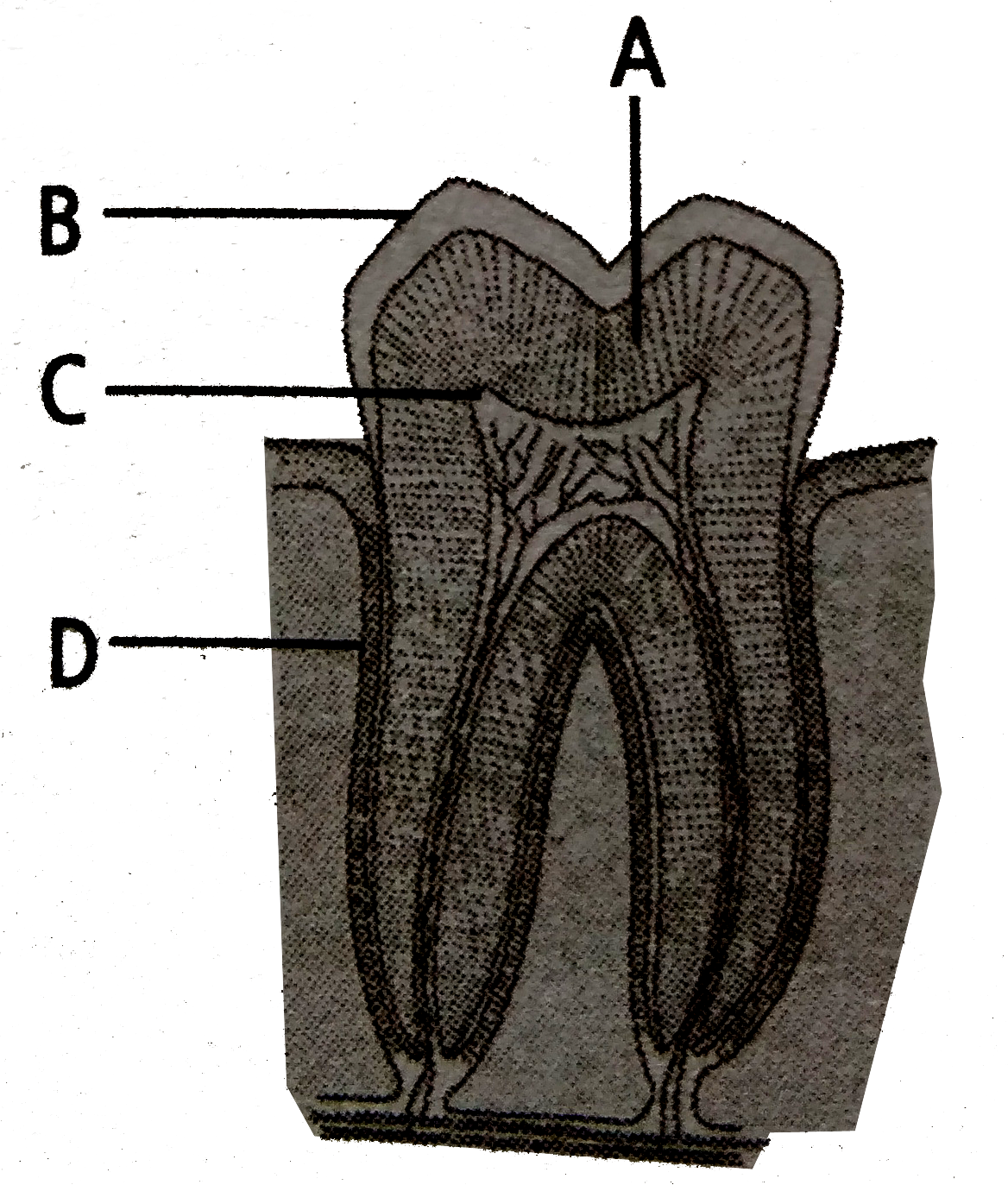
In the given figure of human tooth, some parts are labelled as A,B,C and D identify these parts and match them with their description given below.
(i) Contains mineral matter, mainly calcium
70% mineral matter, mainly calcium
(iii) Hardest material in the body
(iv) Connects root to the jawbone

A

i,ii,iii,iv

B

ii,iii,iv,i

C

iii,ii,iv,i

D

ii,iii,i,iv

Text Solution

Verified by Experts

The correct Answer is:

D

Pulp cavity (ii) dentine
(iii) Enamel (iv) Cement
Promotional Banner

Similar Questions

Explore conceptually related problems

The figure given below shows a small part of human lung where exchange of gas take, place. In which are of the options given below, the one part A, B, C and D is correctly, identified along with its function?

Following is the figure of a saggital section of a human brain.Match the labelled parts with the respective statements given below and select the correct option. (i)Consists of fibre tracts that interconnect left and right hemispheres (ii)Secretes a hormone melatonin (iii)Alcohol interferes with the function of this part (iv)Contains centres which control respiration , cardiovascular reflexes and gastric secretions.

a) Identify the figure given below b) Redraw the structure as a replicating fork and label the parts c) Write the source of energy for this replication and name the enzyme involved in this process. d) Mention the differences in the synthesis of protein, based on the polarity of the two template strands.

a) Identify the figure given below b) Redraw the structure as a replicating fork and label the parts (c) Write the source of energy for this replication and name the enzyme involved in this process. (d) Mention the differences in the synthesis of protein, based on the polarity of the two template strands.

Match the terms given in column I with their descriptions given in column II and select the correct option from the codes given below. {:(,"Column-I",,"Column-II"),((A),"Out-crossing",(i),"Mating of closely related individuals within the same breed"),((B),"Interspecific hybridisation",(ii),"Mating of animals of same breed but having no common ancestors on either side of their pedigree for 4-6 generations"),((C),"Cross-breeding",(iii),"Mating of animals of two different species"),((D),"Inbreeding",(iv),"Mating of animals belonging to different breeds"):}

Match the terms given in column I with their definitions in column II and select the correct answer from codes given below. {:(Column I,Column II),(A."Transformation",(i)"Sequences cut by restriction enzymes"),(B."Recognition site",(ii)"Process by which DNA fragments are separated based on their size"),(C."Gel electrophoresis",(iii)"Plasmid DNA that has incorporated human DNA"),(D."Recombinant DNA",(iv)"Process by which bacteria take up pieces of DNA from the environment"):}

Match column I with column II and select the correct option from the codes given below ltBrgt {:("Column I","Column II"),(A." Uremia",(i)." Ketone bodies in urine"),(B." Ketonuria",(ii)." Artificial kidney"),(C." Glycosuria",(iii)." Glucose in urine"),(D." Blood dialyser",(iv)." Accumulation of urea in blood"):}

Match column I with column II and select the correct option from the codes given below. {:(,"Column I",,"Column II"),(A.,"RER",(i),"Intracellular and extracellular digestion"),(B.,"SER",(ii),"Lipid synthesis"),(C.,"Golgi complex",(iii),"Protein synthesis and secretion"),(D.,"Lysosomes",(iv),"Moves materials out of the cell"):}
