Home
Class 11
BIOLOGY
Rise in the water level from X to Y in t...

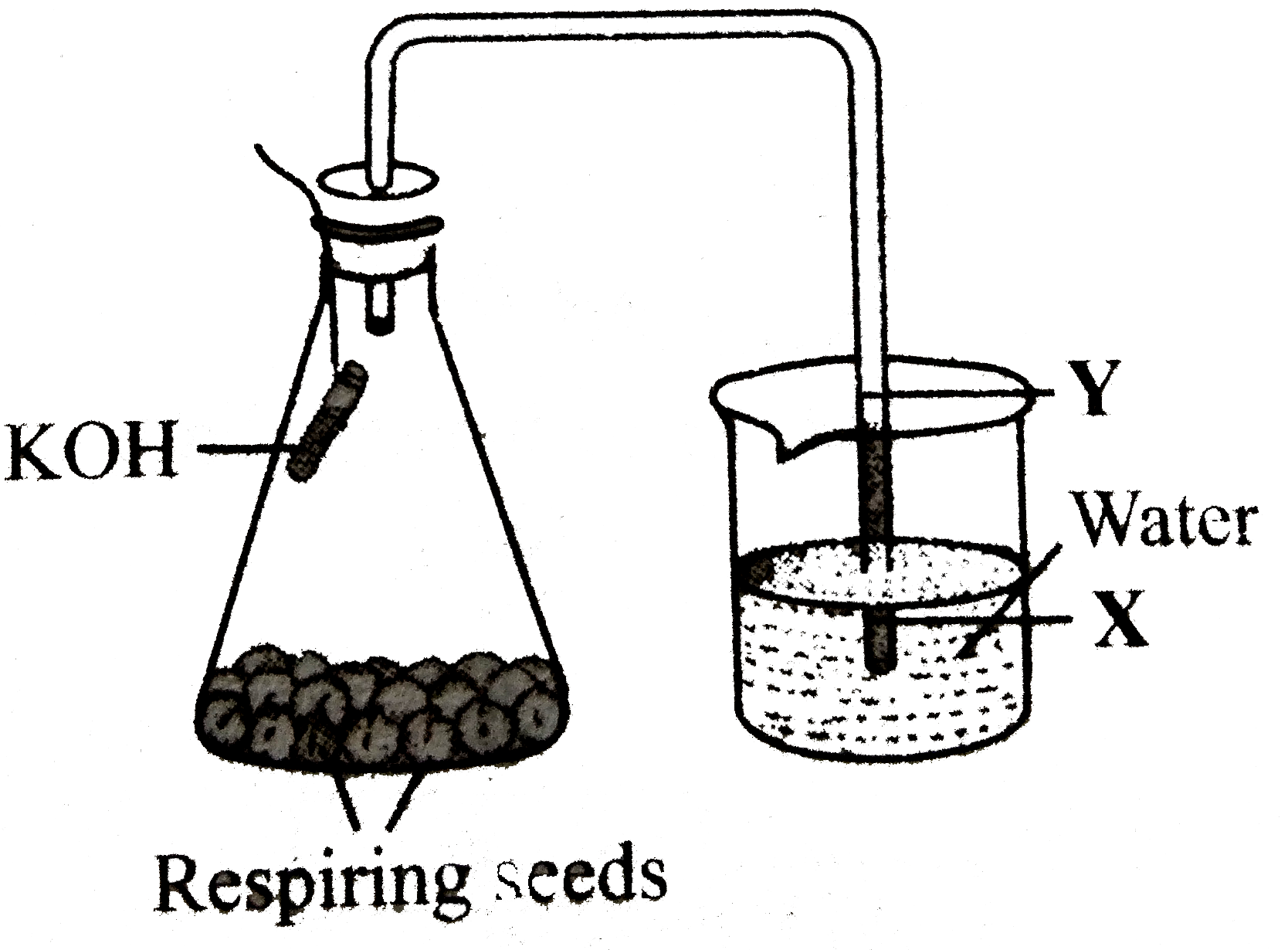
Rise in the water level from X to Y in the given experimental set-up demonstrates

A

aerobic respiration

B

anaerobic respiration

C

photosynthesis

D

transpiration pull

Text Solution

Verified by Experts

The correct Answer is:

A

Oxygen required for aerobic respiration is taken up from the air of the apparatus. Carbon dioxide released during aerobic respiration is absorbed by potassium hydroxide (KOH). Therefore, a partial vacuum us created in the conical flask. This causes the rise of water in the bent tube. That oxygen is consumed during aerobic respiration can be tested by taking a burning splinter into the conical flask, which gets extinguished.
Promotional Banner

Similar Questions

Explore conceptually related problems

The volume of water is a measuring cylinder is 50 ml. When a stone is tied to a string is immersed in the water, the water level rises to 83 ml. Find the volume of the stone.

A man is sitting in a boat which is floating in a pond. If the man drinks some water from the pond, the level of water in the pond decreases. Justify whether the given statement is True (or) False.

Read the paragraph and answer the following question: You must be knowing about the high and low tides that occur regularly in the sea. The level of the sea water at any given location along sea shore increase and decreases twice a day at regular intervals. High and low tides occur at different times at places. The level of water in sea changes because of the gravitational force exerted by the moon. Water directly under the moon gets pulled towards the moon and the level of water there goes up causing high tide at that place. At two places on the earth at 90^(@) from the place of high tide, the level of water is minimum and low tides occur there. How many times the sea level at the coast change?

Read the paragraph and answer the following question: You must be knowing about the high and low tides that occur regularly in the sea. The level of the sea water at any given location along sea shore increases and decreases twice a day at regular intervals. High and low tides occur at different times at places. The level of water in sea changes because of the gravitational force exerted by the moon. Water directly under the moon gets pulled towards the moon and the level of water there goes up causing high tide at that place. At two places on the earth at 90^(@) from the place of high tide, the level of water is minimum and low tides occur there. How does sea level changed?

Assertion(A) : When water is heated up to 100^@C , there is no rise in temperature until all water gets converted into water vapour. Reason : Boiling point of water is 10^@C

Read the paragraph and answer the following question: You must be knowing about the high and low tides that occur regularly in the sea. The level of the sea water at any given location along sea shore increases and decreases twice a day at regular intervals. High and low tides occur at different times at places. The level of water in sea changes because of the gravitational force exerted by the moon. Water directly under the moon gets pulled towards the moon and the level of water there goes up causing high tide at that place. At two places on the earth at 90^(@) from the place of high tide, the level of water is minimum and low tides occur there. Where is high tide and low tide caused?

A 20 cm long capillary tube is dipped in water. The water rises up to 8 cm. If the entire arrangement is put in a freely falling elevator, the length of water column in the capillary tube will be

A U tube will both ends open to the atmosphere, is partially filled with water .Oil which is immiscible with water ,is poured into one side until it stands at va distance of 10mm above the water level on the other side .Mean while the water rises by 65 mm from its original level (see diagram).The density of the oil is :

Statement 1: (5x-5)^2+(5y+10)^2=(3x+4y+5)^2 is a parabola. Statement 2: If the distance of the point from a given line and from a given point (not lying on the given line) is equal, then the locus of the variable point is a parabola.
