Home
Class 11
BIOLOGY
The accompanying figure shows reabsorpti...


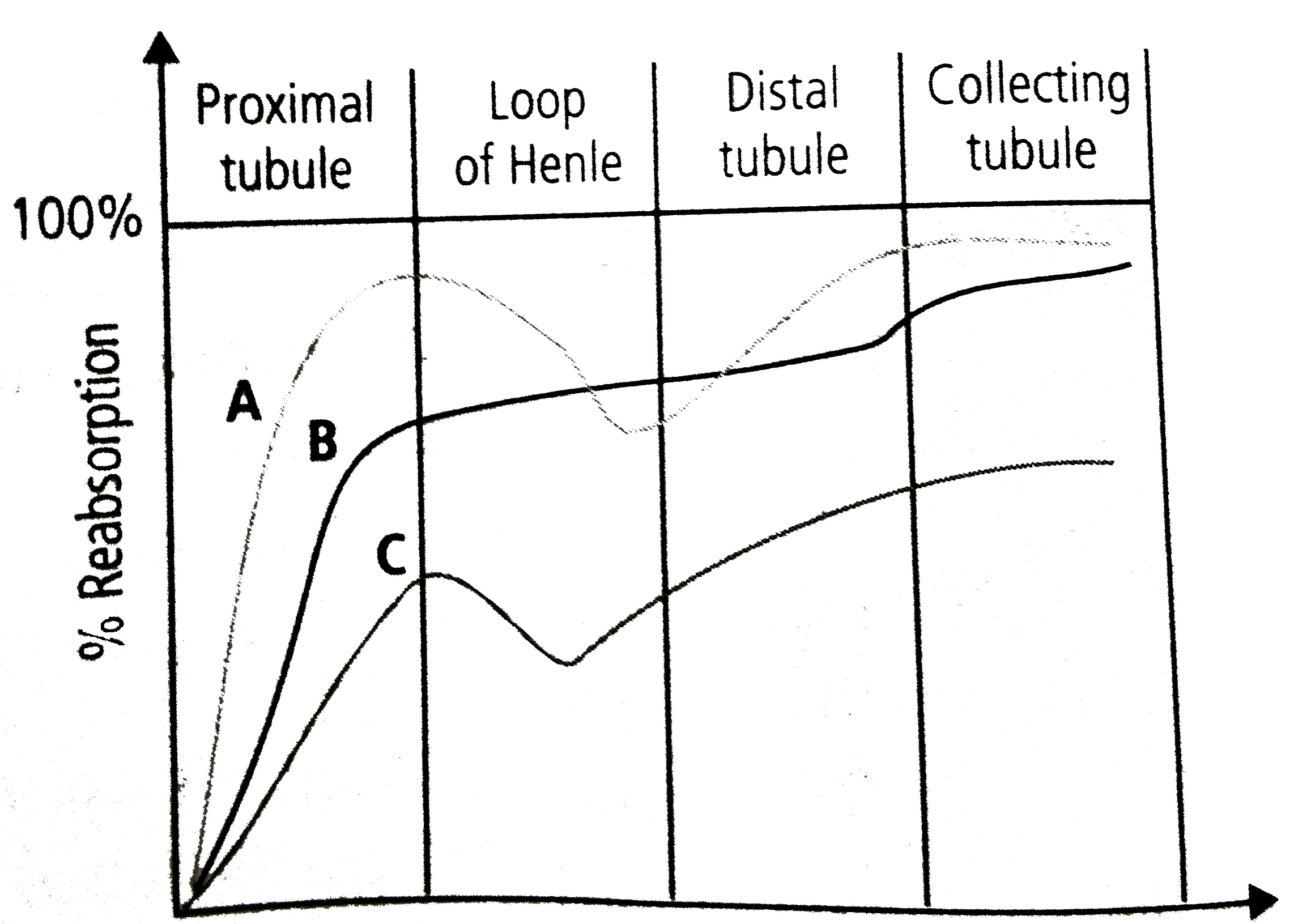
The accompanying figure shows reabsorption of some constituents of glomerular filtrate in different parts of mammalian nephron. What can these constituents be?

A

`A-Na^(+),B-"Water",C-"Urea"`

B

A-Urea, `B-Na^(+)`, C-Water

C

A-Water , B-`Na^(+)`,C-Urea

D

A-`Na^(+)`,B-urea, C-water

Text Solution

Verified by Experts

The correct Answer is:

A

Graph A is for `Na^+`, as the `Na^+` passes through proximal tubule, it's absorption increases. About 60% of `Na^(+)` from glomerular filtrate is absorbed here. Loop of Henle is divided into two parts: (i) descending limb and (ii) ascending limb. Descending lib is impermeable but ascending limb is permeable for `Na^(+).Na^+` reabsorption again increases in distal convoluted tubule under the influence of aldosterone. its absorption also occur in collecting duct but it stabilises here. Graph B is for water. Much of the water is absorbed in proximal tubule. Descending lib of loop of Henle is permeable but ascending limb of loop of Henle is impermeable to water. As the water passes through distal tubule and collecting duct its absorption increases. Graph C is for urea. much of the urea is absorbed in proximal tubule. Descending limb is impermeable but ascending limb is partially permeable to urea. As it passes through in proximal tubule. Descending limb is impeable to urea. As it passes through distal and collecting tubule its absorption also increases.
Promotional Banner

Similar Questions

Explore conceptually related problems

What is selective reabsorption? Give the substance reabsorbed by different segments of the nephron.

The glomerulus of the nephron filtered the blood, and it is called glomerular filtrate. While it is passed through the different segments of nephron, certain substances are selectively reabsorbed. What are the substance reabsorbed and in which segment. Explain.

Identify the biological term. Excretion, glomerulus, urinary bladder, glomerular filtrate, ureters, urine, Bowman's capsule, urinary system, reabsorption, micturition, osmosis, proteins. (a) A liquid which gathers in the bladder. (b) Produced when blood is filtered in a Bowman's capsule. (c) Temporary storage of urine. (d) A ball of inter twined capillaries. (e) Removal of unwanted substances from the body. (f) Each contains a glomerulus. (g) Carry urine from the kidneys to the bladder. (h) Scientific term for urination. (i) Regulation of water and dissolved substances in blood and tissue fluid. (j) Consists of the kidneys, ureters and bladder. (k) Removal of useful substances from glomerular filtrate. (l) What solute the blood contains that are not present in the glomerular filtrate?

The pie diagram in figure 6.13 shows the proportions of different workers in a town. Answer the following questions with its help . What is the percentage of workers in production ?

Figure shows a man standing stationary with respect to a horizontal conveyor belt that is accelerating with 1 m s^(-2) . What is the net force on the man? If the coefficient of static friction between the man’s shoes and the belt is 0.2, up to what acceleration of the belt can the man continue to be stationary relative to the belt ? (Mass of the man = 65 kg.)

Many of the diagrams given in figure show magnetic field lines (thick lines in the figure ) wrongly. Point out what is wrong with them . Some of them may describe electrostatic field lines correctly. Point out which ones.

Shows a smooth pair of thick metallic rails connected across a battery of emf epsilon having a negligible internal resistance. A wire ab of length l and resistance r can slide smoothly on the rails. The entire system lien in a horizontal plane and is immersed in a uniform vertical magnetic field B. At an instant t, the wire is given a small velocity v towards right. (a) find the current in it at this instant. What is the direction of the current? (b) What is the force acting on the wire at this instant? (c) Show that after some time the wire ab will slide with a constant velocity. Find this velocity.

Take three different colour sheets , place one over the other and draw a triangle on the top sheet. Cut the sheets to get triangles of different colour which are identical. Mark the vertices and the angles as shown. Place the interior angles angle1,angle2 and angle3 on a straight line, adjacent to each other, without leaving any gap. What can you say about the total measure of the three angles angle1,angle2 and angle3 ? Can you use the same figure to explain the ''Exterior angle property'' of a triangle ? If a side of a triangle is stretched, the exterior angle so formed is equal to the sum of the two remote interior angles.

Z,A and M represent the atomic number, mass number and rest mass of a nucleus. a. Show that 'M' is always less than the mass of the constituent particles. b. What is this mass difference called ? c. Give the relation.
