Home
Class 12
BIOLOGY
Direction : Carefully read the following...

Direction : Carefully read the following information to answer Q.no.1 and Q.no.2
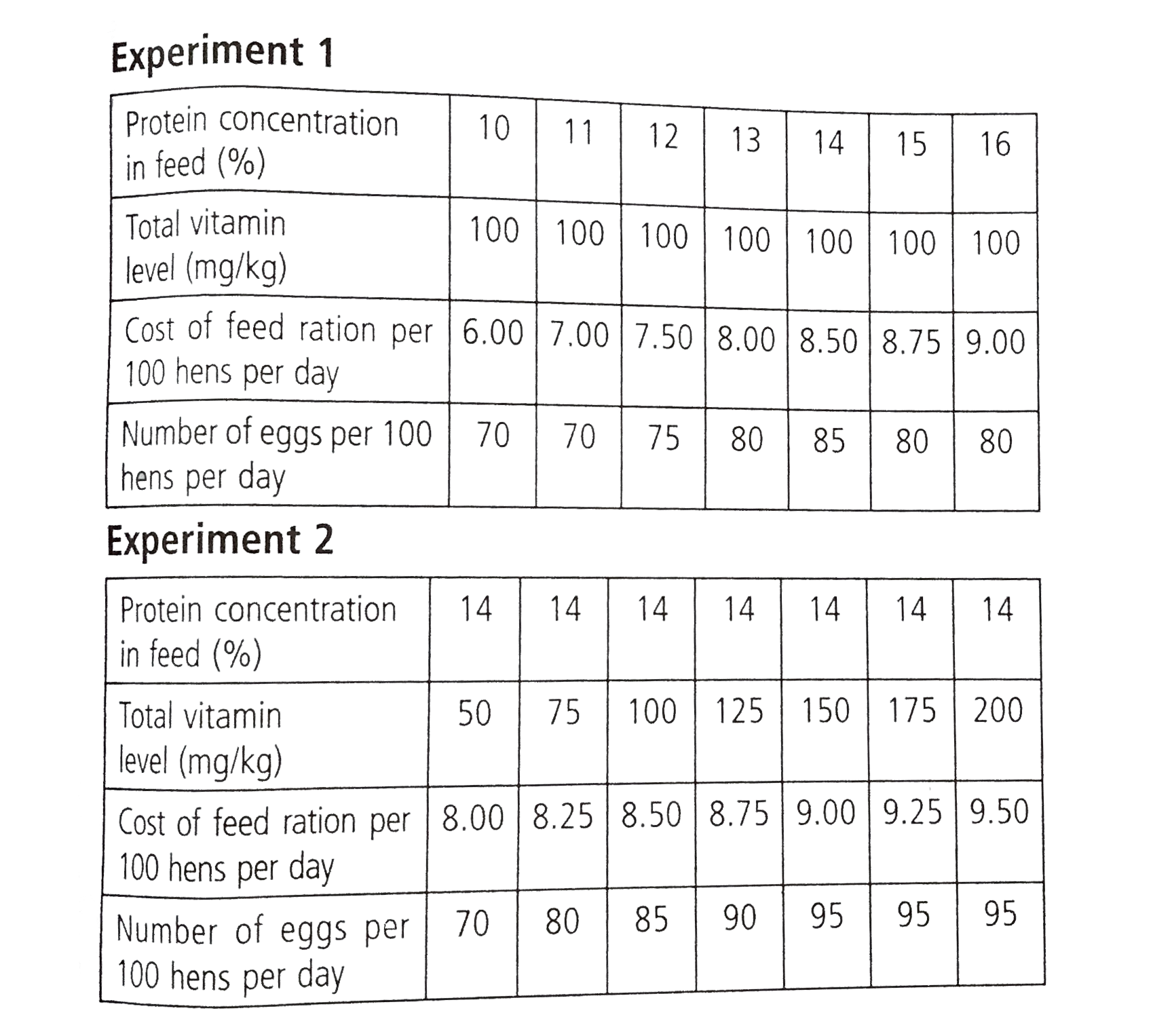
An egg farmer is experimetnting with different feed rations with the aim of increasing his production whilst reducing the cost of the feed per egg produced. The data from two feeding experiments is given below.

Which feed composition give the least cost per egg produced ?

A

`{:("Protein (concentration (%)",,"Total vitamin level" (mg//kg)),(16,,100):}`

B

`{:("Protein (concentration (%)",,"Total vitamin level" (mg//kg)),(14,,50):}`

C

`{:("Protein (concentration (%)",,"Total vitamin level" (mg//kg)),(14,,100):}`

D

`{:("Protein (concentration (%)",,"Total vitamin level" (mg//kg)),(14,,150):}`

Text Solution

Verified by Experts

The correct Answer is:

D

In experiment 1, cost per egg produced from different protein concentrations can be calculated as follows:
Cost per egg `= ("Cost of feed per 100 hens per day")/("Number of eggs per 100 hens per day")`
The calculations show that the cost per egg for different protein concentrations is `0.085, 0.100, 0.100, 0.100, 0.109` and `0.112` respectively.
Similarly in experiment 2, cost per egg is found to be `0.114, 0.103, 0.100, 0.097, 0.094, 0.097` and `0.100` respectively with increased vitamin level. Hence, on analysing the given experimental results, it becomes clear that least cost per egg in incurred in feed with `10%` protein concentration and vitamin level at `100 mg//kg` but out of the given options, option (d) i.e., feed ration with `14%` protein concentration and `150 mg//kg` vitamin level gives the least cost per egg i.e., `0.094`.
Promotional Banner

Similar Questions

Explore conceptually related problems

Direction : Carefully read the following information to answer Q.no.1 and Q.no.2 An egg farmer is experimetnting with different feed rations with the aim of increasing his production whilst reducing the cost of the feed per egg produced. The data from two feeding experiments is given below. What are the independent variable in each of the two experiments?

A farmer mixes two brands P and Q of cattle feed. Brand P, costing Rs 250 per bag, contains 3 units of nutritional element A, 2.5 units of element B and 2 units of element C. Brand Q costing Rs 200 per bag, contains 1.5 units of nutritional element A, 1.25 units of element B, and 3 units of element C. The minimum requirements of nutrients A, B and Care 18 units, 45 units and 24 units respectively. Determine the number of bags of each brand which should be mixed in order to produce a mixture having a minimum cost per bag? What is the minimum cost of the mixture per bag?
