Home
Class 12
BIOLOGY
The given graphs shows the productivity ...

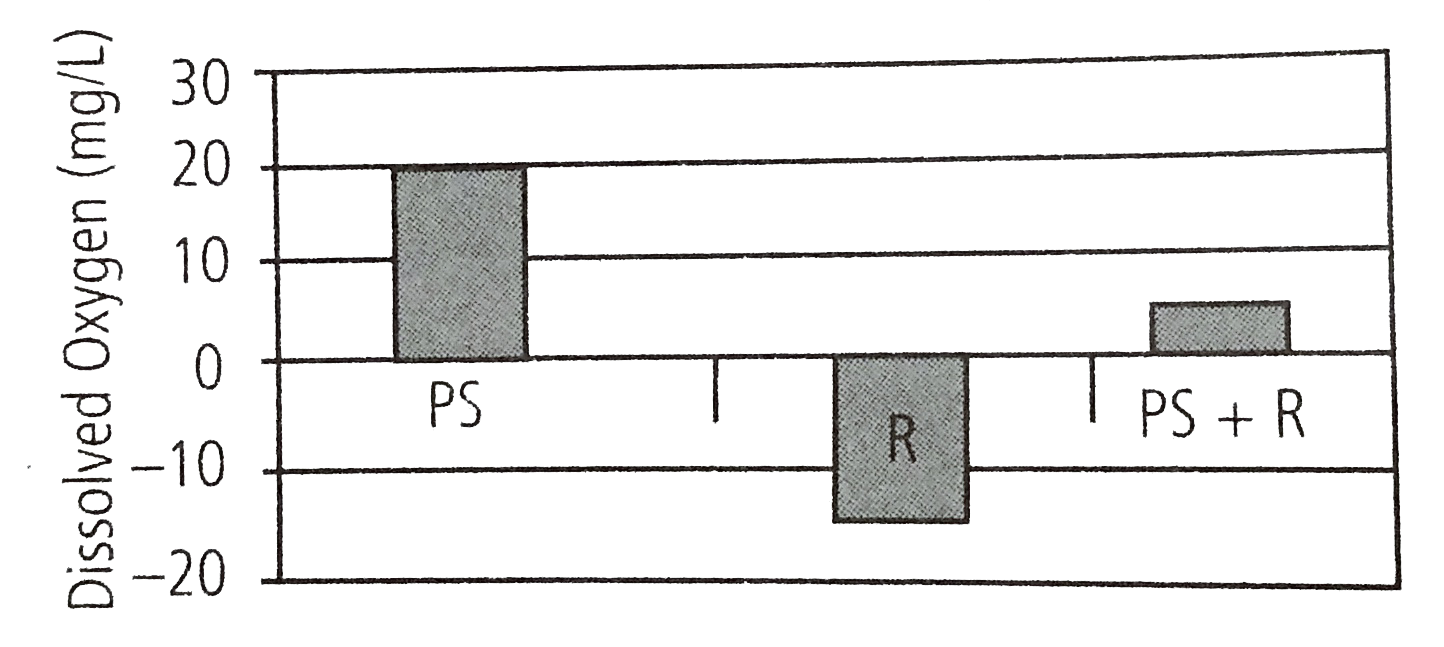
The given graphs shows the productivity of an aquatic ecosystem measured in terms of dissolved oxygen produced and consumed by green plants and photosynthetic algae where PS=photosynthesis and R=respiration. What will happen during algal bloom?

1. PS will be increase, R will be decreased
2. PS will be decreased, R will be increased.
3. PS and R will not change.
4. PS+R will increase.

A

PS will be increase, R will be decreased

B

PS will be decreased, R will be increased.

C

PS and R will not change.

D

PS+R will increase.

Text Solution

Verified by Experts

The correct Answer is:

D

During photosynthesis, green plants produce oxygen which leads to increase in dissolved oxygen in an aquatic ecosystem. Respiration uses oxygen and hence causes decrease in dissolved oxygen. The excess growth of planktonic algae that causes colouration of water is called algal bloom. The increased growth in photosynthetic algae will lead to more photosynthesis which will increase PS+ R ultimately.
Promotional Banner

Similar Questions

Explore conceptually related problems

Assertion (A): Increase in Proton gradient inside lumen reponsible for ATP synthesis Reason (R ): Oxygen evolving complex of PS I located on thylakoid membrane facing Stroma, releases H^+ ions

Column I, Column II a)A circular plate is expanded by heat from radius 6 cm to 6.06 cm. Approximate increase in the area is, b)If an edge of a cube increases by 2%, then the percentage increase in the volume is, c)If the rate of decrease of (x^2)/2-2x+5 is thrice the rate of decrease of x , then x is equal to (rate of decrease in nonzero)., d)The rate of increase in the area of an equailateral triangle of side 30c m , when each side increases at the rate of 0. 1c m//s , is, p. 5 q. 0.72 pi r. 6 s. (3sqrt(3))/2

The volume of a sphere is given by V= 4/3 pi R^3 where R is the radius of the sphere (a). Find the rate of change of volume with respect to R. (b). Find the change in volume of the sphere as the radius is increased from 20.0 cm to 20.1 cm. Assume that the rate does not appreciably change between R=20.0 cm to R=20.1 cm.

Show that the function f given by f(x) = x^(3)-3x^(2)+4x,x in R is increasing on R.

If composite function f_1(f_2(f_3((f_n(x))))n timesis an decreasing function and if r of f_i ' s are decreasing function while rest are increasing, then the maximum value of r(n-r) is (n^2-1)/4 , when n is an even number (n^2)/4, when n is an odd number (n^2-1)/4, when n is an odd number (n^2)/4, when n is an even number

The expansion 1+x,1+x+x^(2),1+x+x^(2)+x^(3),….1+x+x^(2)+…+x^(20) are multipled together and the terms of the product thus obtained are arranged in increasing powers of x in the form of a_(0)+a_(1)x+a_(2)x^(2)+… , then, The value of (a_(r ))/(a_(n-r)) , where n is the degree of the product.
