Home
Class 12
CHEMISTRY
Which of the following reaction shall pr...

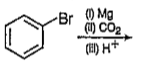
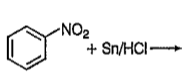
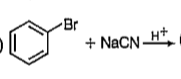
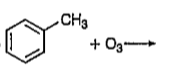
Which of the following reaction shall produce benzoic acid ?

A

B

C

D

Text Solution

AI Generated Solution

The correct Answer is:

To determine which reactions produce benzoic acid, we will analyze the given reactions step by step. ### Step 1: Analyzing the first reaction with bromobenzene and magnesium (Mg) 1. **Starting Material**: Bromobenzene (C6H5Br) 2. **Reaction with Magnesium**: When bromobenzene reacts with magnesium in dry ether, it forms a Grignard reagent (C6H5MgBr). 3. **Reaction with Carbon Dioxide**: The Grignard reagent (C6H5MgBr) then reacts with carbon dioxide (CO2) to form a carboxylate intermediate (C6H5COOMgBr). 4. **Hydrolysis**: Upon hydrolysis (addition of water), the carboxylate intermediate converts to benzoic acid (C6H5COOH). **Conclusion for Step 1**: This reaction produces benzoic acid. ### Step 2: Analyzing the second reaction with nitrobenzene and HCl 1. **Starting Material**: Nitrobenzene (C6H5NO2) 2. **Reduction with HCl**: The nitro group (NO2) is reduced to an amino group (NH2) using HCl and a reducing agent. 3. **Final Product**: The product of this reaction is aniline (C6H5NH2), not benzoic acid. **Conclusion for Step 2**: This reaction does not produce benzoic acid. ### Step 3: Analyzing the third reaction with bromobenzene, sodium cyanide (NaCN), and HCl 1. **Starting Material**: Bromobenzene (C6H5Br) 2. **Nucleophilic Substitution**: When bromobenzene reacts with sodium cyanide (NaCN), the bromine atom is replaced by a cyano group (C≡N), forming benzonitrile (C6H5CN). 3. **Hydrolysis**: Upon hydrolysis (addition of water and acid), benzonitrile is converted to benzoic acid (C6H5COOH). **Conclusion for Step 3**: This reaction produces benzoic acid. ### Step 4: Analyzing the fourth reaction 1. **Starting Material**: The details of the fourth reaction are not provided, but based on the previous analysis, we can conclude that if it does not involve a pathway to form a carboxylic acid from a suitable precursor, it will not yield benzoic acid. **Conclusion for Step 4**: This reaction does not produce benzoic acid. ### Final Answer The reactions that produce benzoic acid are: 1. The reaction of bromobenzene with magnesium followed by carbon dioxide and hydrolysis. 2. The reaction of bromobenzene with sodium cyanide followed by hydrolysis.
Promotional Banner

Similar Questions

Explore conceptually related problems

Which of the following reaction can produce pyro acid?

Decarboxylation of which of the following acid gives benzoic acid –

Which of the following statement (s) about benzoic acid is (are) correct?
