Home
Class 12
CHEMISTRY
Heating 1,2 dibromocyclohexane with 2 eq...

Heating 1,2 dibromocyclohexane with 2 equivalents of alcoholic KOH yields

A

B

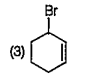
C

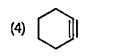
D

Text Solution

AI Generated Solution

The correct Answer is:

To solve the question of what product is formed when heating 1,2-dibromocyclohexane with 2 equivalents of alcoholic KOH, we can follow these steps: ### Step 1: Identify the Reactants We start with 1,2-dibromocyclohexane, which has two bromine atoms attached to the first and second carbon of the cyclohexane ring. ### Step 2: Understand the Reaction Conditions We are using 2 equivalents of alcoholic KOH. Alcoholic KOH is a strong base and promotes elimination reactions rather than substitution reactions. ### Step 3: Determine the Type of Reaction Since we are using alcoholic KOH, we can expect an elimination reaction (specifically, an E2 mechanism) to occur. In this reaction, we will remove a bromine atom and a hydrogen atom to form a double bond. ### Step 4: Elimination of Bromine and Hydrogen 1. The first equivalent of KOH will remove one bromine atom (Br) and a hydrogen atom (H) from adjacent carbons (C1 and C2). 2. This will form a double bond between C1 and C2, resulting in the formation of a cyclohexene derivative. ### Step 5: Consider the Stability of the Product Since we have two equivalents of KOH, we can perform another elimination. The second equivalent of KOH can remove another bromine atom (if present) and a hydrogen atom from the adjacent carbon to create a more stable alkene. In this case, the major product will be a conjugated diene due to the stability of the double bonds formed. The most stable product will be 1,3-hexadiene, as it allows for conjugation. ### Final Product The final product of heating 1,2-dibromocyclohexane with 2 equivalents of alcoholic KOH will be **1,3-hexadiene**. ### Summary of Steps: 1. Identify the reactants (1,2-dibromocyclohexane). 2. Recognize the reaction conditions (alcoholic KOH). 3. Determine the type of reaction (elimination). 4. Perform the elimination to form a double bond. 5. Consider the stability of the product to find the major product (1,3-hexadiene).
Promotional Banner

Similar Questions

Explore conceptually related problems

Chloroform with alcoholic KOH gives

1,2-dibromopropane is heated with one mole of alcoholic KOH. The reaction is expected to produce

Trans - 2 phenyl 1 - bromocyclopenta ne on reaction with alcoholic KOH produces

C_(6)H_(6)CI_(6) on treatment with alcoholic KOH yields .

1, 2 - Dibromocyclohexane on dehydrobromination gives:

Which product is formed when trans-2-phenyl-1-bromocyclopentane is treated with alcoholic KOH?
