Home
Class 12
BIOLOGY
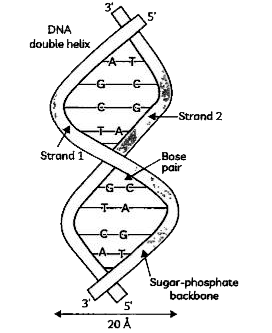
The given structure was proposed with th...

The given structure was proposed with the help of X-ray diffraction data produced by:

A

Erwin Chargaff

B

Maurice Wilkins and Rosalind Franklin.

C

Mischer and Harvey

D

Frederick Griffith

Text Solution

Verified by Experts

Promotional Banner

Topper's Solved these Questions

  • SAMPLE PAPER (SELF-ASSESSMENT)-11

    EDUCART PUBLICATION|Exercise SECTION -C|1 Videos

Similar Questions

Explore conceptually related problems

Early crystallographers had trouble solving the structures of inorganic solids using X-ray diffraction because some of the mathematical tools for analyzing the data had not yet been developed. Once a trial structure was proposed, it was relatively easy to calculate the diffraction pattern, but it was difficult to go the other way (from the diffraction pattern to the structure) if nothing was known a priori about the arrangement of atoms in the unit cell. It was important to develop some guidelines for guessing the coordination numbers and bonding geometries of atoms in crystals. The first such rules were proposed by Linus Pauling, who considered how one might pack together oppositely charged spheres of different radii. Pauling proposed from geometric considerations that the quality of the "fit" depended on the radius ratio of the anion and the cation. If the anion is considered as the packing atom in the crystal, then the smaller cation fills interstitial sites ("holes"). Cations will find arrangements in which they can contact the largest number of anions. If the cation can touch all of its nearest neighbour anions then the fit is good. If the cation is too small for a given site, that coordination number will be unstable and it will prefer a lower coordination structure. The table below gives the ranges of cation/anion radius ratios that give the best fit for a given coordination geometry. A solid AB has square planar structure. If the radius of cation A^+ is 120pm,Calculate the maximum possible value of anion B^-

Early crystallographers had trouble solving the structures of inorganic solids using X-ray diffraction because some of the mathematical tools for analyzing the data had not yet been developed. Once a trial structure was proposed, it was relatively easy to calculate the diffraction pattern, but it was difficult to go the other way (from the diffraction pattern to the structure) if nothing was known a priori about the arrangement of atoms in the unit cell. It was important to develop some guidelines for guessing the coordination numbers and bonding geometries of atoms in crystals. The first such rules were proposed by Linus Pauling, who considered how one might pack together oppositely charged spheres of different radii. Pauling proposed from geometric considerations that the quality of the "fit" depended on the radius ratio of the anion and the cation. If the anion is considered as the packing atom in the crystal, then the smaller cation fills interstitial sites ("holes"). Cations will find arrangements in which they can contact the largest number of anions. If the cation can touch all of its nearest neighbour anions then the fit is good. If the cation is too small for a given site, that coordination number will be unstable and it will prefer a lower coordination structure. The table below gives the ranges of cation/anion radius ratios that give the best fit for a given coordination geometry. The radius of Ag^+ ion is 126pm and of I^- ion is 216pm. The coordination number of Ag^+ ion is:

Early crystallographers had trouble solving the structures of inorganic solids using X-ray diffraction because some of the mathematical tools for analyzing the data had not yet been developed. Once a trial structure was proposed, it was relatively easy to calculate the diffraction pattern, but it was difficult to go the other way (from the diffraction pattern to the structure) if nothing was known a priori about the arrangement of atoms in the unit cell. It was important to develop some guidelines for guessing the coordination numbers and bonding geometries of atoms in crystals. The first such rules were proposed by Linus Pauling, who considered how one might pack together oppositely charged spheres of different radii. Pauling proposed from geometric considerations that the quality of the "fit" depended on the radius ratio of the anion and the cation. If the anion is considered as the packing atom in the crystal, then the smaller cation fills interstitial sites ("holes"). Cations will find arrangements in which they can contact the largest number of anions. If the cation can touch all of its nearest neighbour anions then the fit is good. If the cation is too small for a given site, that coordination number will be unstable and it will prefer a lower coordination structure. The table below gives the ranges of cation/anion radius ratios that give the best fit for a given coordination geometry. A "good fit" is considered to be one where the cation can touch:

Three dimensional structure of t-RNA was proposed by :

X-rays are produced

The ring structure of benzene was first proposed by :

For X–ray diffraction, order of wave length is

X -rays are produced by jumping of:

EDUCART PUBLICATION-SAMPLE PAPER (SELF-ASSESSMENT )-9-MULTIPLE CHOICE QUESTIONS
  1. Pleiotropy is the effect of X = gene(s) on Y = ……………….. phenotypic exp...

    Text Solution

    |

  2. Which among these are coded by only one codon ?

    Text Solution

    |

  3. Which among these are roles played by ribosomes:

    Text Solution

    |

  4. Capping II involves the addition of ................ . to the 5'-end o...

    Text Solution

    |

  5. The only spot in a seed where the integuments are absent around ovule ...

    Text Solution

    |

  6. Which among these characteristics is not required for a substance to b...

    Text Solution

    |

  7. The given structure was proposed with the help of X-ray diffraction da...

    Text Solution

    |

  8. A case dispfaying a pedigree across a family: The trait included ...

    Text Solution

    |

  9. The cause of chromosomal disorders is absence or excess of abnormal ar...

    Text Solution

    |

  10. In sickle cell anaemia glutamic acid is replaced by valine. Which one ...

    Text Solution

    |

  11. Removal of anthers from the flower bud before the anther dehisces in c...

    Text Solution

    |

  12. Under which of these conditions there is no need for emasculation?

    Text Solution

    |

  13. Pollen tube enters the ovule through ………………………….. .

    Text Solution

    |

  14. Emasculated flowers are bagged in order to:

    Text Solution

    |

  15. Artificial hybridisation involves:

    Text Solution

    |

  16. Bagging is mostly done using-

    Text Solution

    |

  17. The given structure was called by another name before the postulation ...

    Text Solution

    |

  18. The given procedure is illegal used in many parts of the world to dete...

    Text Solution

    |

  19. Name the procedure that can be adopted in an individual having the fol...

    Text Solution

    |

  20. Observe the given figiure. lntine is made up of.

    Text Solution

    |

