Home
Class 10
MATHS
In a rhombus BEST,if / B=60^(@) and BT =...


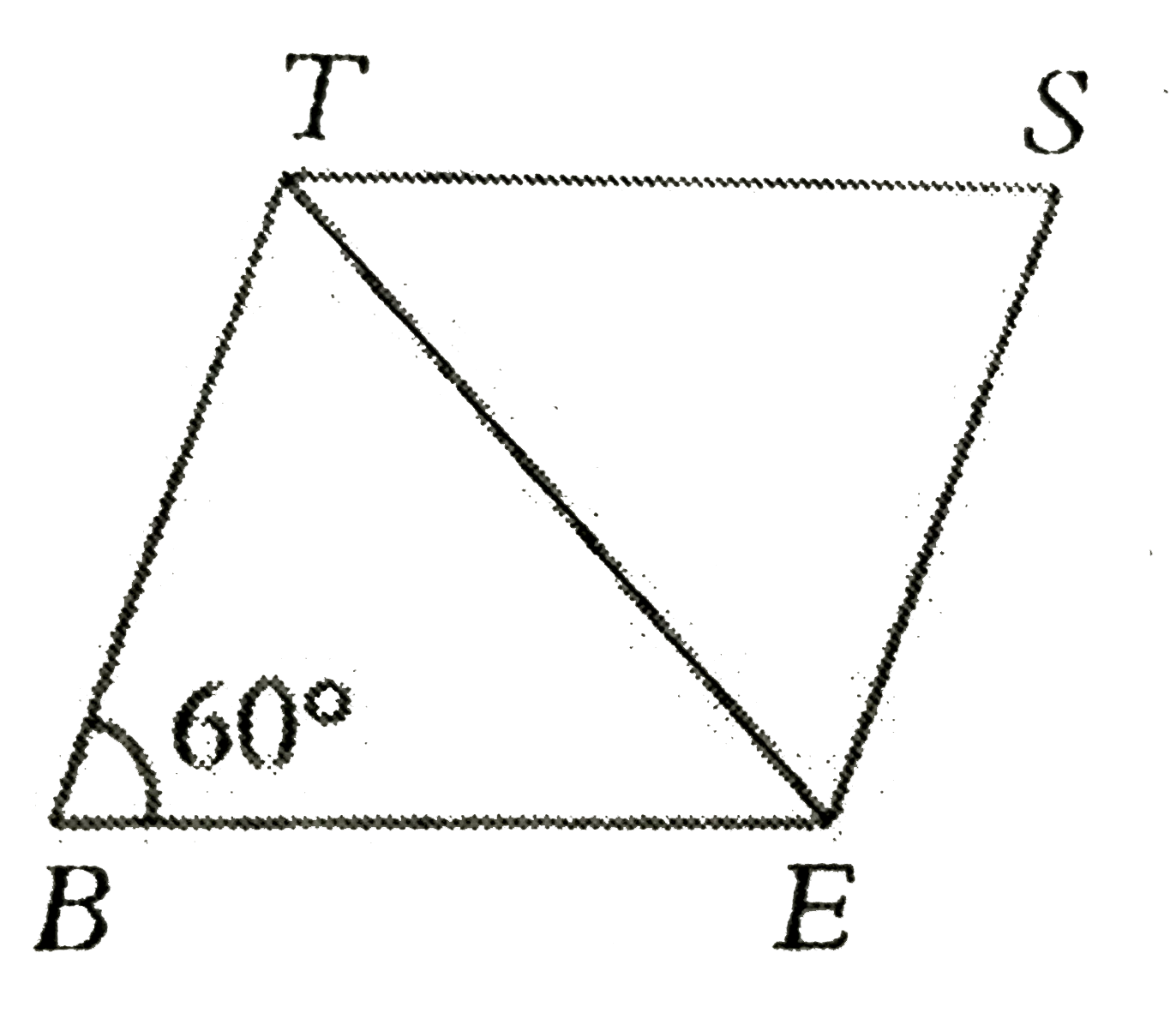
In a rhombus BEST,if `/_ B=60^(@)` and `BT =6cm`, then find the length of the diagonal TE.
The following are the steps involved in solving the above problem. Arrange them in sequential order.
(A) `implies Delta` BTE is an equilateral triangle.
(B) Join T and E
(C ) In `Delta BET, BT=BE implies /_ BTE =/_ BET =(180^(@)-60^(@))/(2)=60^(@) ( :' /_ B=60^(@))` .
(D) `TE=6 `cm

A

83 cm

B

86 cm

C

117.4 cm

D

130.4 cm

Text Solution

Verified by Experts

The correct Answer is:

C
Promotional Banner

Similar Questions

Explore conceptually related problems

If 169 = b^(2)+25 then find the value of b .The following sentences are the steps involved in solving the above problem .Arrange them in sequential order from the first to the last

Prove that measure of each of an equilateral triangle is 60^(0)

Prove that each angle of an equilateral triangle is 60^(0)

If tan(A+B)=1 and A(-B)=(1)/(sqrt(2)) , then find A and B. The following are the steps involved in solving the above problem. Arrange them in sequential order. (A) tan (A+B)=1implies tan (A+B)=tan45^(@) and sin(A-B)=(1)/(sqrt(2))implies sin(A-B)=sin45^(@) . (B) 2A=90^(@)implies A=45^(@) . (C ) A+B=45^(@) and A-B=45^(@) . (D) :. A=45^(@) and B=0^(@) .

The perimeter of an equilateral triangle is 60 m. The area is

If n(A) = 6 and n(B) = 8 and n(A nn B) = 4 , then find n(A Delta B) . The following are the step involved in solving the above problem . Arrange them in sequnential order. (a) n (A uu B) = n(A) + n(B) - n(A nn B) (b) n(A uu B) = 10 (c ) n(A uu B) =6+8-4 (d) n(A Delta B) = 10-4= 6 (e) n(A Delta B) = n(A uu B) - n(A nn B) .

The perimeter of an equilateral triangle is 60m. The area is

If cos(A-B)=(1)/(2) and sin(A+B)=(sqrt(3))/(2) , then find A and B The following are the steps involved in solving the following problem. Arrange them in sequential order. (A) 2A=120^(@)implies A=60^(@) (B) :. A=60^(@),B=0^(@) . (C ) cos(A-B)=(1)/(2) implies cos(A-B) = cos60^(@) and sin(A+B)=(sqrt(3))/(2)implies sin(A+B) = sin 60^(@) . (D) A+B=60^(@) and A-B=60^(@) .
